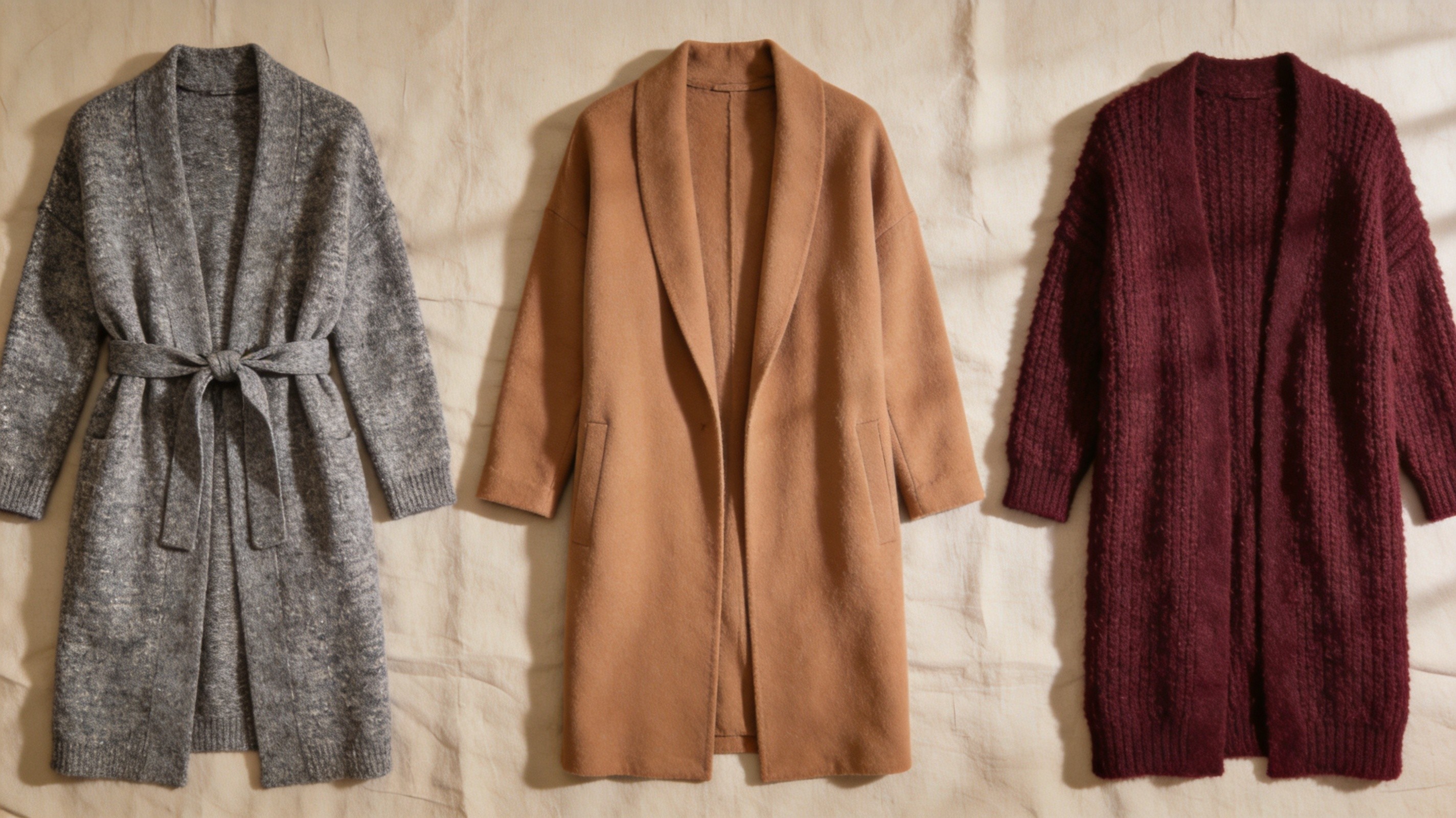
The Coatigan Explained: How the Viral Cardigan-Coat Hybrid Became AW2026's Must-Stock Layer — A Complete B2B Sourcing Guide
Some trends climb the ladder slowly, from runway to editorial to retail. The coatigan jumped it in three weeks flat. What began in Week 46 as a faint "knitted jacket" signal, confirmed in Week 47 as a cardigan-jacket hybrid blurring two categories, has now detonated into mainstream consumer consciousness: on October 21, the Chicago Tribune's BestReviews declared coatigans "the viral fall fashion staple everyone is buying," popping up all over Instagram and TikTok. For buyers researching a coatigan wholesale B2B program, this is the exact blue-ocean pattern that rewarded early movers on deep V-necks in Week 46 and fitted cardigans in Week 47 — a consumer term going viral while precisely zero B2B sourcing content exists to serve the demand it creates.
This guide covers the complete commercial picture: the three-week trend arc from fashion signal to viral staple, the construction specification that separates a true coatigan from an ordinary long cardigan, the three product categories worth buying, the behavioral reasons the garment went viral now, fiber and gauge recommendations, design specifications for tech packs, color strategy, merchandising angles, FOB pricing bands, MOQ guidance, and the quality-control checkpoints that a heavier structured knit demands.
The Trend Story: From Fashion Weeks to "The Viral Fall Fashion Staple"
The coatigan's trajectory is a textbook case of how a silhouette earns a B2B guide. Week 46 brought the first signal: knitted jackets in the Mango and Victoria Beckham orbits, substantial enough to read as outerwear. Week 47 delivered confirmation when Elle.pl dedicated a feature to the cardigan jacket that "blurs the line between sweater and jacket." Week 48 is the explosion — the Chicago Tribune's BestReviews published a dedicated coatigan shopping guide on October 21, naming it the cardigan/coat mash-up that is perfect for fall and the viral staple everyone is buying.
The retail validation is already stacked at every price tier, which is what separates a durable category from a one-week hashtag:
- Amazon volume tier: ANRABESS, LILLUSORY, PRETTYGARDEN, and GRACE KARIN all have coatigan programs live, with the LILLUSORY belted trench-style version emerging as a category-defining model.
- Premium tier: Anthropologie is selling statement versions — a fringe duster and a faux-fur collar tapestry duster — confirming the style carries price points well above basics.
- High-street styling tier: Cosmopolitan UK (October 15) spotlighted Mango's scarf-collar coatigan at $100, a two-in-one design with a detachable scarf that the magazine styled three ways — work, weekend, and evening — calling it two layers for the price of one.
The styling frame doing the viral work on Instagram and TikTok is the "airport outfit": the coatigan as the hero layer of trans-seasonal travel dressing — soft enough to sleep in, structured enough to arrive in. That solves a real wardrobe problem — and retail buyer research typically trails consumer virality by days, not months.
What Defines the Coatigan? The Spec Sheet
Reordering a generic long cardigan and relabeling it will miss the trend. The consumer press has already trained shoppers on what a coatigan is, and the construction markers are specific.
The Gap It Fills
The coatigan exists for the temperature window where it is too cold for a cardigan and too early for a coat. That functional positioning is the product's entire reason for being, and it should anchor both weight specification and merchandising copy.
Heavier-Knit Construction
The single clearest divider between a coatigan and a regular long cardigan is fabric substance. The Chicago Tribune's construction markers start with heavier-knit fabrics: the garment must hold a coat-like line from shoulder to hem rather than drape like a jersey layer. In practice this means chunky 3GG–5GG knits for duster styles and a compact 7GG for structured versions — territory covered in our knit gauge guide.
Structured Shoulders
This is the blazer-function detail. Pravda's FW2026/27 trend feature documents the return of the structured shoulder, an elevated shoulder line that makes a knit "function like a blazer." In a coatigan, shoulder structure is what lets the garment read as outerwear, and it is the element factories most often under-engineer. Whether achieved through light padding or knitted-in structure, the shoulder must stand up to the heavier body fabric.
Coat-Like Details
Lapels, belts, and oversized or patch pockets are the visual vocabulary the coatigan borrows from tailoring. A lapel collar in knit requires engineered stability to roll correctly; belts need reinforced loops or knitted tie channels; oversized patch pockets — a signature of the category — need stress-point reinforcement at the corners.
The Length Spectrum
Coatigan lengths run mid-thigh through knee to maxi and ankle-grazing duster. The mid-thigh-to-knee band is the commercial core; the maxi duster serves the Anthropologie statement tier.
The Scarf-Collar Two-in-One
Mango's $100 formula — a coatigan with an integrated detachable scarf collar — is the premium product insight of the season: the two-in-one pitch doubles the styling content per garment and gives marketing a single-image story. It is the highest-value SKU variant in the category and the clearest differentiator for a structured shoulder cardigan manufacturer program aiming above the Amazon tier.
Three Categories of Coatigans
1. The Classic Duster Coatigan
Open front, mid-thigh to knee, chunky 3GG–5GG knit, patch pockets. This is the volume engine of the category — the silhouette the Amazon brands are selling hardest and the easiest entry point for a first duster cardigan B2B program.
2. The Belted Trench Coatigan
Structured shoulders, lapel collar, belted waist — the LILLUSORY model that anchors the mid tier. This is where the cardigan-coat hybrid becomes literal: trench-coat architecture executed in a compact 7GG knit. It carries the strongest "blazer alternative" narrative and the widest styling range.
3. The Statement Coatigan
Fringe hems, faux-fur collars, tapestry-effect knits — the Anthropologie tier. Lower volume, higher margin, and the version that generates press and Pinterest saves. Buyers with premium distribution should treat the statement coatigan as the category's image driver.
Why the Coatigan Went Viral Now
Four forces converged to make this the season's breakout layer, and each one is a durable demand driver rather than a fleeting aesthetic.
- Trans-seasonal dressing: unpredictable autumn temperatures have made layering a functional necessity, and the coatigan is the single garment engineered for the cardigan-to-coat gap.
- The comfort-formality bridge: it is soft as a cardigan yet polished as a coat — the exact post-athleisure compromise consumers keep rewarding.
- Social media math: Cosmopolitan's work/weekend/evening styling formula means one garment generates three styling videos per creator. Virality compounds when a product is this content-efficient.
- The anti-oversize paradox: the coatigan is roomy but structured, which lets it serve both market tracks at once. It satisfies the volume customer while answering the fitted, waist-defining correction we documented in our fitted cardigan guide — belted versions literally deliver both stories in one garment.
For buyers, the practical read is simple: the coatigan is not a trend bet, it is a category formation. Garments that solve a functional gap and generate endless styling content tend to become multi-season basics — the trajectory the chunky cardigan followed, as covered in our grandpa cardigan sourcing guide.
Materials & Fiber Recommendations
Fiber choice should follow category tier, with weight and drape as the governing requirements — a coatigan must hang like outerwear, not cling like a cardigan.
| Fiber | Typical Yarn Count | Character | Retail Position |
|---|---|---|---|
| Acrylic/cotton blend | 2/32NM class | Light bulk, accessible price, easy care | The volume duster — Amazon tier |
| Wool blend | 2/26NM–2/32NM | Weight plus drape, holds structure | The workhorse — belted trench and mid tier |
| Wool-cashmere blend | 2/26NM class | Soft, warm, premium handfeel | Premium tier — Anthropologie positioning |
| Brushed / melange yarns | 2/16NM–2/26NM equivalent | Visual depth, surface interest | The texture story — grey melange hero styles |
| Alpaca blends | 2/16NM–2/26NM equivalent | Cozy-luxury warmth, fluffy surface | The material-story differentiator |
Wool blends are the default for structured styles: enough body to support lapels and shoulders, enough drape for a mid-thigh silhouette to move. Wool-cashmere serves the premium tier where handfeel justifies the ticket. Brushed and melange yarns deliver the visual depth Pravda flagged in its FW2026/27 texture coverage and are the natural vehicle for the grey melange hero color. Alpaca blends extend the cozy-luxury fiber shift we have tracked since Week 47 — the same shift behind the UK high street's premium fiber expansion — and give a coatigan wholesale program a fiber narrative acrylic-only competitors cannot match. Our yarn selection guide matches counts to end use in detail.
Design Specifications for B2B Buyers
These specifications belong in every coatigan tech pack. Gauge controls structure; GSM controls whether the garment reads as outerwear or as a cardigan that outgrew its brief.
| Spec | Classic Duster | Belted Trench | Statement / Two-in-One |
|---|---|---|---|
| Gauge | 3GG–5GG | 7GG compact | 3GG–7GG by design |
| Target GSM | 450–600 | 380–480 | 400–650 |
| Primary fibers | Acrylic/cotton, wool blend | Wool blend | Wool-cashmere, alpaca blend |
| Shoulder | Soft, slightly dropped | Structured (padded or knitted-in) | Design-dependent |
| Closure | Open front | Belted, optional buttons | Belt, buttons, or scarf collar |
| Length | Mid-thigh to knee | Knee to below-knee | Knee to maxi |
Shoulder Construction
Specify the method, not just the look: light removable padding gives the sharpest blazer line; knitted-in structure — a denser shoulder panel or short-row shaping — survives washing better and suits the mid tier. Either way, require the shoulder to hold its line after the specified wash cycle.
Lapel Engineering
A knit lapel fails when it collapses or curls. Specify a doubled lapel construction or a denser collar knit, define the roll line in the pattern, and check lapel memory at sample stage and after washing.
Belt Systems and Pockets
Knitted tie belts should run through reinforced channel loops anchored at the side seams, not tacked to the body fabric. Buckled belts need knitted or woven carriers rated for the garment's weight. Patch pockets — the category's signature — require corner reinforcement and a test for mouth gaping when loaded.
Closures and Length Grading
For styles worn buttoned as a top — the Cosmopolitan evening formula — plackets must lie flat with smooth-backed buttons at blouse standards, as detailed in our fitted cardigan guide. Grade length consistently across the size run: a mid-thigh spec that shrinks to hip length in larger sizes breaks the product promise.
Color Strategy
| Color Direction | Mood | Retail Role |
|---|---|---|
| Grey melange | The viral neutral | The hero shade — Mango's coatigan grey and the balaclava-pairing color of the season |
| Camel / chocolate | The rich-mom palette | The belted trench's natural home; anchors premium layering edits |
| Burgundy | Rich, confident | Tenth consecutive week as the #1 color — the lowest-risk fashion shade on the market |
| Cloud Dancer white / ivory | Soft, luminous | The Pantone Color of the Year 2026 story — white shows knit texture best |
| Black | Polished, evening | The day-to-night option; the trench coatigan reads sharpest in black |
Grey melange should lead the opening buy — it is the color the viral coverage is actually showing, and melange yarns give it the depth that photographs well. Camel and chocolate supply the premium trench tier. Burgundy, in its tenth consecutive week at #1, connects the coatigan to the season's wider color narrative covered in our color-pop knitwear guide. Cloud Dancer white — Pantone's Color of the Year 2026 — is the fresh story: on a heavier-gauge coatigan, ivory surfaces make cable and rib texture read at distance, a genuine merchandising advantage.
Styling & Merchandising Angle
The Cosmopolitan three-way formula is ready-made retail content for lookbooks, Pinterest, and email:
- Work: belted coatigan over stretch trousers with a kitten heel — the blazer alternative.
- Weekend: open duster with jeans and chocolate loafers, scarf collar attached.
- Evening: buttoned up and worn as a top with a satin midi skirt — the day-to-night flip.
- The third piece story: merchandise the coatigan as the outfit-completing third piece adjacent to trousers, denim, and skirts, not only in the knitwear bay.
The coatigan also cross-sells with the season's knit balaclavas and berets, and with the layering pieces in our deep V-neck sourcing guide — a complete trans-seasonal capsule from one delivery window.
Pricing & MOQ Guide
| Product Type | Fiber / Construction | Indicative FOB | MOQ |
|---|---|---|---|
| Classic duster coatigan | Acrylic/cotton blend, 3GG–5GG | $9–$14 | 200 pcs/color |
| Belted trench coatigan | Wool blend, 7GG, structured shoulder | $12–$18 | 200 pcs/color |
| Premium statement coatigan | Wool-cashmere, fringe / faux-fur collar | $16–$24 | 200 pcs/color |
| Scarf-collar two-in-one | Wool blend, detachable scarf collar | $14–$22 | 200 pcs/color |
The category spans accessible volume to premium statement, and standard knitwear markups support healthy margins at every tier — a $12–$18 wool-blend trench coatigan retails comfortably in the premium high-street band where Mango's $100 two-in-one is already validating the price point. The working minimum is 200 pcs per color. A practical first program is three styles — a grey melange duster, a camel belted trench, and a burgundy or ivory statement piece — creating a complete coatigan story in six to nine SKUs.
Quality Control: Structure-First Checkpoints
Coatigan QC concentrates on structure retention, because the coat illusion is the product. Include these checks in your AQL inspection:
- Shoulder structure retention: padding or knitted-in structure must hold the elevated shoulder line after the specified wash cycle; check for migration, clumping, or collapse.
- Seam strength at stress points: pull-test pocket corners, belt loops, and belt channels; these are the highest-load points in a heavier garment.
- Pilling resistance: ICI pilling grade 3–4 or better, with attention to high-friction zones — under arms, and where handbag straps cross the shoulder and hip.
- Length and drape consistency: measure the full size run against graded length specs; heavier knits amplify grading errors.
- Lapel roll and collar memory: lapels must roll at the designed line and recover after washing; scarf-collar attachments must sit flat and detach cleanly.
- Dimensional stability: shrinkage within ±3% after wash — critical at 450+ GSM where absolute shrinkage translates into visible length loss.
- Color fastness: grey melange, camel, and burgundy require dry and wet crocking at grade 4 minimum, 4–5 for export.
For inspection flow and AQL setup, our knitwear quality-control guide covers the full process from sampling to final random inspection.
How New Narwhal Can Help
New Narwhal helps buyers capture the coatigan moment while the B2B content window is still wide open. Based in Taizhou within China's leading knitwear cluster, we operate as knitwear curation and supply-chain specialists — not as a factory. Your gauge, weight, structure, fiber, and price targets are matched to vetted manufacturers genuinely equipped for heavier structured knit production, rather than forced onto a single volume line.
- Develop duster, belted trench, statement, and scarf-collar two-in-one programs across acrylic/cotton, wool blend, wool-cashmere, and alpaca-blend tiers
- Produce gauge, GSM, yarn-count, shoulder, lapel, belt, and pocket specifications ready for bulk
- Source chunky-gauge and structured-knit workshops with verified lapel and shoulder engineering
- Manage sampling, lab dips, structure-retention and fastness testing, and third-party inspection
- Work within the 200-pcs-per-color minimum and consolidate multi-style orders
Ready to build your coatigan assortment?
New Narwhal helps B2B buyers source the right knitwear, from the right manufacturers, at the right price.
Key Takeaways & Related Sourcing Guides
- The coatigan is AW2026's viral layer. Week-3 trend confirmation plus Chicago Tribune "viral staple" coverage plus Amazon-to-Anthropologie retail depth equals a category, not a fad.
- The spec is defined: heavier knits (3GG–7GG), structured shoulders, lapels, belts, oversized pockets, mid-thigh to maxi lengths — and the scarf-collar two-in-one as the premium SKU.
- Three tiers, one buy: classic duster for volume, belted trench for the mid tier, statement coatigan for margin and press.
- FOB runs $9–$24 by tier, with 200 pcs per color as the working MOQ; grey melange leads, burgundy holds #1 for a tenth week, Cloud Dancer white is the fresh story.
- QC is structure-first: shoulder retention, lapel memory, pocket and belt-loop strength, and drape consistency before bulk ships.
Related sourcing guides:
- Canton Fair Phase 3: The Complete Knitwear Buyer's Sourcing Playbook — where to scout coatigans and structured knits, October 31–November 4
- The Fitted Cardigan Comeback: How 90s Minimalism Is Reshaping AW2026 Wholesale Knitwear — the waist-defining counter-trend that pairs with the coatigan
- Chunky Knit Grandpa Cardigans — B2B Sourcing Guide — the chunky-gauge volume track adjacent to the duster
- Argyle & Fair Isle Knitwear: The Haute Heritage Pattern Boom — B2B Sourcing Guide — pattern programs for the same delivery window
- Architectural Knits & Balloon Sleeves — B2B Sourcing Guide — the structured-shoulder story behind the trench coatigan
- Color-Pop Knitwear — B2B Sourcing Guide — the color foundation for burgundy-led ranges
- Sourcing Knitwear in the Taizhou Cluster — how the supply base behind this category works