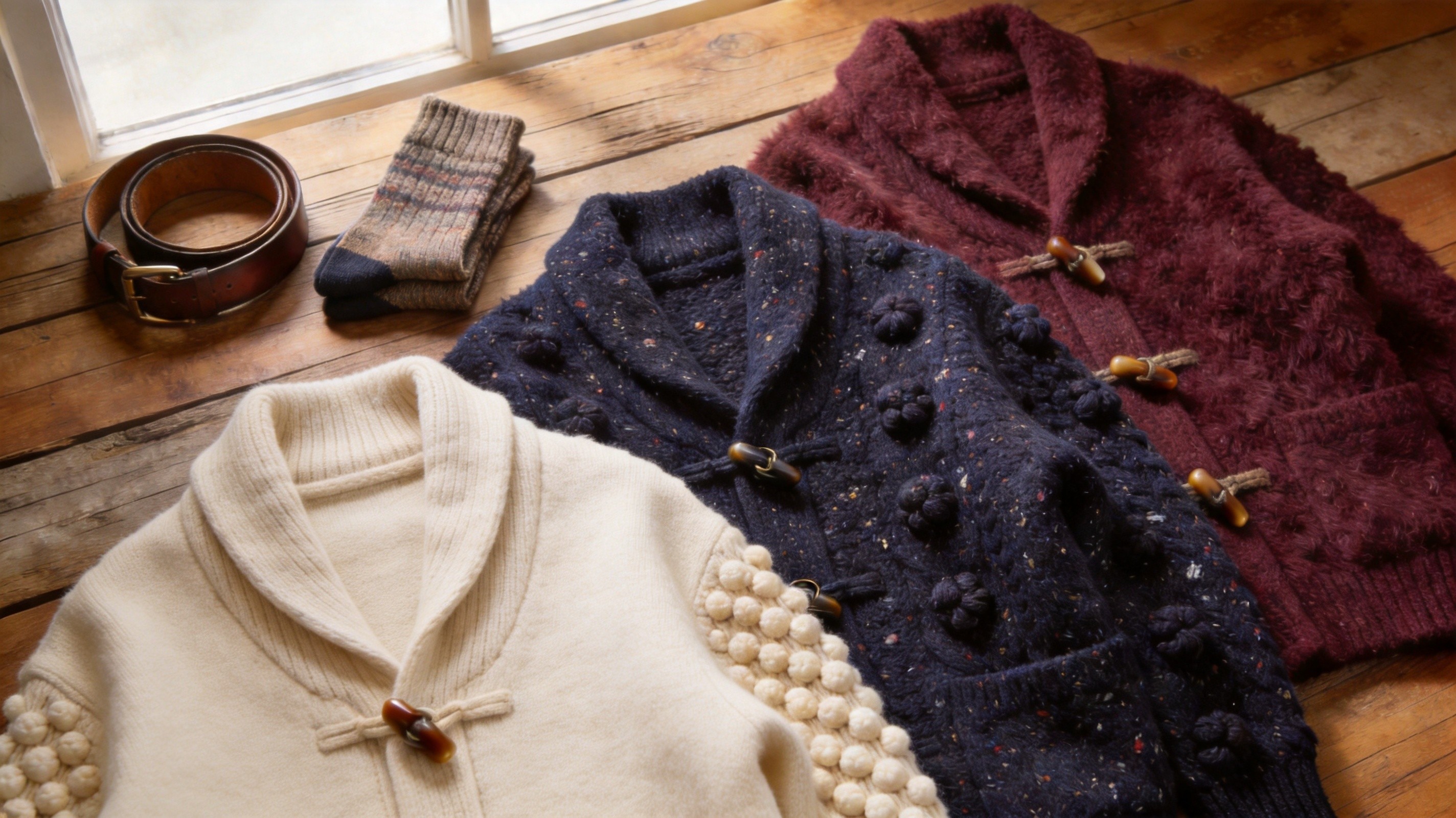
Chunky-Knit Cardigans & the Grandpa Knit Aesthetic: AW2026's Return to Character Knitwear — A B2B Sourcing Guide
After several seasons of sleek, fitted, almost engineered cardigans, knitwear is swinging back toward character. As Daily Times 247 put it on October 4: "Cardigans for the last year or so have been sleek, waisted — but 2026 is ushering in the return of the chunky knit cardigan." Elle Poland went further in its October 2 feature, naming "grandpa knit" — deliberately retro, textured, imperfect cardigans — as "the sweater that defines fall 2026."
This is more than a seasonal texture story. The brands validating it span the full spectrum of the market: Magda Butrym, Altuzarra, and Kseniaschnaider on the fashion side; COS with a flecked chunky wool-alpaca cardigan; Dôen with a cream wool-cashmere version; and The Row's Poynta cashmere cardigan at the luxury apex. The aesthetic principle behind every one of them is simple and quotable: "the thicker the knit, the more character," and "the more it looks like a great sweater found in a vintage shop, the more interesting the effect."
For buyers building a chunky knit cardigan wholesale B2B program, the opportunity is concrete: heavy-gauge knits carry higher perceived value, command stronger margins than fine-gauge basics, and reward manufacturers with genuine stitch and fiber capability. This guide covers what defines grandpa knit, the four silhouettes to buy, fibers and yarn specifications, stitch patterns, color strategy, FOB pricing and MOQ, styling-driven commercial value, and the QC points that heavy knits demand.
The Trend Story: From Sleek Waisted Knits to Deliberate Imperfection
The pivot away from polished, body-conscious cardigans has been building alongside the wider revival of heritage, craft, and preppy references across fashion. What changed in autumn 2026 is the speed and unanimity of validation. Within one week, three distinct sources — Elle Poland, the Daily Times 247/Who What Wear knitwear roundup, and the runways of Magda Butrym and Altuzarra — converged on exactly the same conclusion: chunky is back, and it is supposed to look lived-in rather than new.
- The editorial verdict. Elle Poland dedicated an October 2 feature to grandpa knit as the defining sweater of the season, describing visible cables, contrasting buttons, pockets, and trims as the elements that give the genre its charm — "the thicker the knit, the more character."
- The market confirmation. The October 4 eight-trend roundup explicitly framed 2026 as the year of the chunky cardigan's return after a long run of sleek, waisted styles — the clearest possible signal that the pendulum has swung for buyers planning next autumn.
- The luxury and contemporary proof points. Magda Butrym, Altuzarra, and Kseniaschnaider showed chunky interpretations in their AW collections; COS, Dôen, and The Row proved the aesthetic works in wool-alpaca, wool-cashmere, and pure cashmere. When three fiber tiers appear at three price levels in one season, the trend is a category, not a capsule novelty.
What Defines "Grandpa Knit"? Five Design Signatures
Grandpa knit is not simply "a thick cardigan." It is a specific set of design choices that collectively create the impression of a beloved garment passed down or rediscovered. Buyers evaluating a retro style cardigan supplier should check for all five:
- Visible stitch patterns: Cables, bobbles, fisherman/aran ribs, and textured panels sit on the surface rather than hiding in a smooth jersey. The hand should read as craft at a glance.
- Contrasting buttons: Horn, corozo, wooden, or vintage-style buttons in a tone visibly different from the body — dark horn on cream, for instance. Uniform plastic buttons break the illusion instantly.
- Pockets: Patch pockets reinforce the vintage utility read most directly; welt and hidden pockets keep the look cleaner but lose some charm. Pockets are non-negotiable for the authentic version.
- The "found in a vintage shop" aesthetic: Slight slouch, relaxed shoulders, muted or flecked color, and a soft (not crisp) hand. The garment should feel pre-worn in the best sense.
- Deliberately "not too modern or sterile": Perfect symmetry and a flawless, dense finish are the enemy. Subtle irregularity in stitch tension and marl distribution is part of the design language — within QC tolerance, not a defect excuse.
Four Silhouettes of Chunky Cardigans
1. Classic Button-Through (Traditional, Straight-Cut)
The heartland grandpa piece: straight body, V or crew neck, five or six contrasting buttons, patch pockets, and cable or fisherman panels. It is the lowest-risk shape, the easiest to grade across sizes, and the natural depth SKU in any grandpa style cardigan wholesale assortment. Volume lives here.
2. Flared-Collar (The Polished Fashion Take)
Magda Butrym's expression of the trend pairs chunky stitch with a defined, slightly flared collar and a closer body — heritage texture with a fashion silhouette. This is the style that pulls the category into dressed and evening-adjacent territory and justifies premium pricing. It needs disciplined collar construction; a flared collar that droops loses the effect entirely.
3. Jacket-Shaped (Structured Outerwear Replacement)
Kseniaschnaider's structured approach treats the cardigan as a jacket: straight set-in shoulders, firmer gauge, toggles or large buttons, and a hem around the hip. The shape extends the cardigan into outerwear sell-through and works in unisex and masculine-leaning ranges. Dense low-gauge knit (3GG–5GG) is required so the body holds a line instead of collapsing.
4. Oversized Cocoon (Slouchy Comfort)
COS's relaxed cocoon cardigan — echoed across the contemporary high street — drops the shoulder, widens the body, and wraps the wearer in volume. This is the strongest loungewear-adjacent and weekend shape, and the most natural home for fuzzy wool-alpaca and brushed fibers. Specify dropped-shoulder grading carefully; over-sized volume must be engineered, not created by simply ordering a bigger size.
Materials & Fiber Guide
| Fiber | Character | Reference Direction | Best Silhouette | Position |
|---|---|---|---|---|
| Wool-alpaca blend | Flecked, fuzzy, warm with lightness | COS navy/chocolate chunky cardigan | Oversized cocoon, classic | Contemporary premium — the signature AW2026 blend |
| Wool-cashmere blend | Soft, refined, less fuzzy | Dôen cream cardigan | Classic, flared-collar | Approachable luxury |
| 100% cashmere | Ultimate softness and recovery | The Row Poynta cashmere cardigan | Classic straight-cut | Luxury apex |
| Heavy merino | Smooth, durable, crisp cables | Accessible premium tier | Jacket-shaped, classic | The value-to-quality entry point |
| Mohair / brushed blends | Hairy, ethereal, soft-focus surface | Runway texture direction | Oversized cocoon | Fashion-forward accent |
Wool-alpaca is the defining blend of the revival: alpaca adds warmth, fuzz, and the flecked character that carries the COS look, while wool supplies structure and recovery. Wool-cashmere moves upmarket without the price of pure cashmere — the Dôen formula. 100% cashmere anchors the luxury tier, as The Row's Poynta demonstrates, and should be knit at gauges dense enough to avoid floppiness. Merino is the correct choice when buyers need a wool alpaca chunky cardigan look at a lower cost or a crisp jacket-shaped knit. Mohair blends earn their place as one or two fashion-forward SKUs rather than depth, since the fuzzy surface polarizes some customers and requires special shedding control.
Texture & Stitch Pattern Options
| Stitch | Surface Effect | Gauge Range | Mood |
|---|---|---|---|
| Cable knit | Raised twisted ropes | 5GG–7GG | Classic preppy — the safest heritage read |
| Flecked / marl | Mixed-color heather surface | 3GG–7GG | COS signature — contemporary and understated |
| Bobble / stipple | Dots and popcorn relief | 5GG–7GG | Playful, handcrafted charm |
| Fisherman / aran | Mixed ribs, cables, and moss panels | 3GG–5GG | Maximum heritage craft appeal |
| Brushed / mohair | Fuzzy haloed surface | 3GG–5GG | Soft, ethereal, modern |
Cable and fisherman stitches carry the heritage narrative most directly and pair naturally with horn buttons and patch pockets. Flecked marl is the most contemporary option — the COS formula — and the best vehicle for the navy-and-chocolate pairing. Bobble stitches add playful surface interest for younger assortments, while brushed and mohair finishes deliver texture you can see before you touch. Combining two stitches in one garment — cable fronts over a plain back, for example — controls weight and cost while keeping the visual story intact.
Specifications for B2B Buyers
Heavy knits fail differently from fine ones: weight pulls at shoulders and hems, and generous gauge demands accurate GSM control. These specs belong in every tech pack.
| Spec | Contemporary Chunky | Heritage Heavy | Luxury Dense |
|---|---|---|---|
| Gauge | 5GG–7GG | 3GG–5GG | 5GG–7GG (fine cashmere yarns) |
| Target GSM | 350–480 | 480–650 | 320–450 |
| Typical yarn count | Wool-alpaca 2/16NM–2/20NM | Roving / low-count chunky yarn | Cashmere 2/26NM–2/28NM |
| Primary fibers | Wool-alpaca, heavy merino | Wool blends, brushed yarns | Cashmere, wool-cashmere |
| Buttons / closure | Horn, corozo, wooden — contrast | Large horn or toggles | Mother-of-pearl or tonal horn |
| Pockets | Patch or welt | Patch, jacket-style | Welt or hidden |
Sizing, Length, and Hardware
- Body length: 58–68 cm for classic and cocoon shapes; jacket-shaped versions hit 60–65 cm around the hip. Longer lines read as coatigans and extend the outerwear story.
- Button size: 20–25 mm on classic bodies; up to 28–30 mm on 3GG heritage and toggle styles. Every button needs a reinforced backer — heavy knits sag around unreinforced closures.
- Rib trims: Deep 8–12 cm cuffs and hems hold shape against the garment's weight; shallow ribs curl and stretch in heavy pieces.
- Shoulder construction: Specify reinforced shoulder seams or saddle/raglan joins on oversized styles — dropped shoulders in heavy gauge carry the entire body weight from two seams.
For the mechanics of matching density to stitch, our gauge guide explains how heavy gauge changes structure, and the yarn selection guide compares wool-alpaca, cashmere, and mohair behavior in production.
Color Strategy for Chunky Knits
| Color | Mood | Stitch / Hardware Match | Retail Role |
|---|---|---|---|
| Cream / ivory | Soft, vintage, luxe | Cables with dark horn buttons | Hero color — The Row and Dôen direction |
| Navy × chocolate | Flecked, rich, understated | Marl wool-alpaca | COS signature combo; depth neutral |
| Burgundy | Autumnal, warm, bold | Fisherman ribs, horn buttons | Seventh consecutive season as the #1 accent |
| Moss / forest green | Nature-inspired, heritage | Cable and aran panels | Emerging neutral with preppy alignment |
| Charcoal / heather grey | Everyday, versatile, muted | Marl or plain chunky knit | Volume basic — the easy reorder |
Cream is the hero shade for grandpa knit because it carries the vintage narrative most convincingly and shows cable relief at its best — the color common to both The Row and Dôen. Navy mixed with chocolate in flecked yarn is the COS signature and the most contemporary neutral in the range. Burgundy continues an extraordinary seven-week run as the season's dominant accent and translates naturally into heavy heritage stitches. Moss and forest greens extend the nature-and-craft story, while charcoal and heather grey supply the everyday reorder color that keeps the category commercially dependable.
Pricing & MOQ Guide
| Product Type | Fiber / Construction | Indicative FOB | MOQ | Retail Role |
|---|---|---|---|---|
| Merino chunky cardigan | Heavy merino, 5GG–7GG, cables | $7–$14 | 200 pcs/color | Accessible entry tier |
| Wool-alpaca chunky cardigan | Flecked wool-alpaca, 3GG–7GG | $8–$16 | 200 pcs/color | Contemporary signature — COS direction |
| Wool-cashmere blend | Wool-cashmere, 5GG–7GG | $12–$22 | 200 pcs/color | Approachable luxury — Dôen direction |
| 100% cashmere chunky cardigan | Pure cashmere, dense 5GG–7GG | $18–$35 | 200 pcs/color | Investment luxury — The Row tier |
The core trend band across the market runs roughly $8–$22 FOB; pure cashmere programs extend above it. At standard 3x–4.5x markups, the category covers accessible weekend knits through investment pieces. A practical opening order places depth in wool-alpaca (two colors, including a navy-chocolate fleck), adds one cream wool-cashmere style for the luxury-leaning customer, and tests one merino cable SKU at the opening price.
Styling Versatility = Commercial Value
The grandpa cardigan's retail strength is that one garment answers several wardrobing needs. Train sales teams around four ways to wear it:
- Open — the duster effect: A long or oversized cardigan worn open over a simple base creates a long, relaxed line that substitutes for a light coat indoors and in transitional weather. This is the easiest entry look for younger customers.
- Buttoned — the polished cardigan: Fastened with the contrast buttons on show, it reads as a proper top, office-ready over a shirt or tee. The visible hardware becomes the outfit's focal point.
- Belted — the waisted silhouette: Adding a belt over the cardigan reshapes the volume and connects the chunky revival back to the sleek styles it replaced — giving one garment both aesthetics.
- Layered — over shirts and dresses: Chunky cardigans over collared shirts, turtlenecks, slip dresses, or shirt-dresses are the defining layered formula of the season and extend the piece across every dress code in the store.
Quality Control: Heavy-Knit Checkpoints
Chunky cardigans carry their own failure modes — weight, stitch integrity, and hardware performance. Include these checks in inspection:
- Button pull and attachment: Buttons and loops bear the pull of a heavy garment. Pull-test every closure to a defined force and require reinforced backers; a popped button on a coatigan is a near-certainty without them.
- Buttonhole integrity: Heavy yarns fray around buttonholes unless bound or densely stitched. Check for loose loops and stretching after 50+ fastening cycles.
- Shoulder and seam strength: The shoulders of dropped and oversized styles support the full garment weight. Require reinforced seams and pull-test on samples; inspect for dropped stitches across cable panels.
- Stitch consistency: Cables and bobbles must be uniform in size and tension across sizes and operators — pattern drift is the most visible defect on surface-led knits.
- Pocket security: Patch pockets sag and pull at their corners under actual use. Require bartacked or reinforced corners and check the reverse for distortion.
- Pilling and abrasion: Wool-blend and wool-alpaca bodies pill under arms and at cuffs; request ICI pilling results at grade 3–4 minimum.
- Mohair shedding: Brushed and mohair styles must be finished to control fiber loss; excessive shedding onto inner layers is a legitimate rejection point.
- Color fastness: Burgundy, forest green, and chocolate require dry and wet crocking at grade 4+ (4–5 for export), plus wash fastness — flecked yarns need each component shade checked.
- Dimensional stability: Heavy ribs and dense bodies can shrink or grow; require shrinkage within ±5% and check length on the hanger, where unsupported heavy knits can stretch over time.
Our knitwear quality-control guide sets out the full AQL inspection flow, and the care and labeling guide covers the instructions that keep heavy knits in shape after purchase.
How New Narwhal Can Help
The grandpa knit revival rewards suppliers who combine heavy-gauge capability with trim and craft discipline — and New Narwhal matches buyers to exactly those manufacturers. Based in Taizhou within China's leading knitwear cluster, we work as knitwear curation and supply-chain specialists, not as a factory. Your silhouette, fiber, stitch, and price targets go to vetted partners genuinely equipped for them, rather than onto a single production line.
- Develop classic, flared-collar, jacket-shaped, and cocoon programs across the full FOB band
- Produce gauge, GSM, yarn-count, stitch-pattern, hardware, and reinforcement specifications ready for bulk
- Source wool-alpaca, wool-cashmere, and pure cashmere programs with verified heavy-gauge capability
- Manage sampling, lab dips, horn and wooden hardware, and third-party pull, pilling, and fastness testing
- Negotiate around the 200-pcs-per-color minimum and consolidate multi-style, multi-fiber orders
Ready to build your chunky knit cardigan assortment?
New Narwhal helps B2B buyers source the right character knitwear, from the right manufacturers, at the right price.
Related Sourcing Guides
- Frog Fastening Cardigans: The Breakout Closure of AW2026 — B2B Sourcing Guide — the detail trend, including toggle closures on jacket-shaped knits
- Color-Pop Knitwear: The Bold Color Revolution — B2B Sourcing Guide — the color context for burgundy and forest-green chunky styles
- Funnel-Neck Knitwear: The Dominant Silhouette — B2B Sourcing Guide — the sleek counterpoint to oversized grandpa knits
- Sourcing Knitwear in the Taizhou Cluster — how the supply base behind this category works
Key Takeaways for B2B Buyers
- 2026 is the year character knits return. Elle Poland names grandpa knit the sweater of the season; Magda Butrym, COS, Dôen, and The Row validate it across every tier.
- Five signatures define the look: visible stitches, contrasting buttons, pockets, vintage charm, and deliberate imperfection — insist on all five for authentic grandpa programs.
- Four silhouettes cover the market: classic button-through, flared-collar, jacket-shaped, and oversized cocoon — with the classic carrying depth.
- Wool-alpaca is the signature blend; FOB pricing spans roughly $7–$35 from merino to pure cashmere, at 200 pcs per color.
- Cream is the hero color, with navy-chocolate fleck, burgundy, moss green, and charcoal completing the range — QC button pull, seam strength, and stitch consistency before bulk ships.