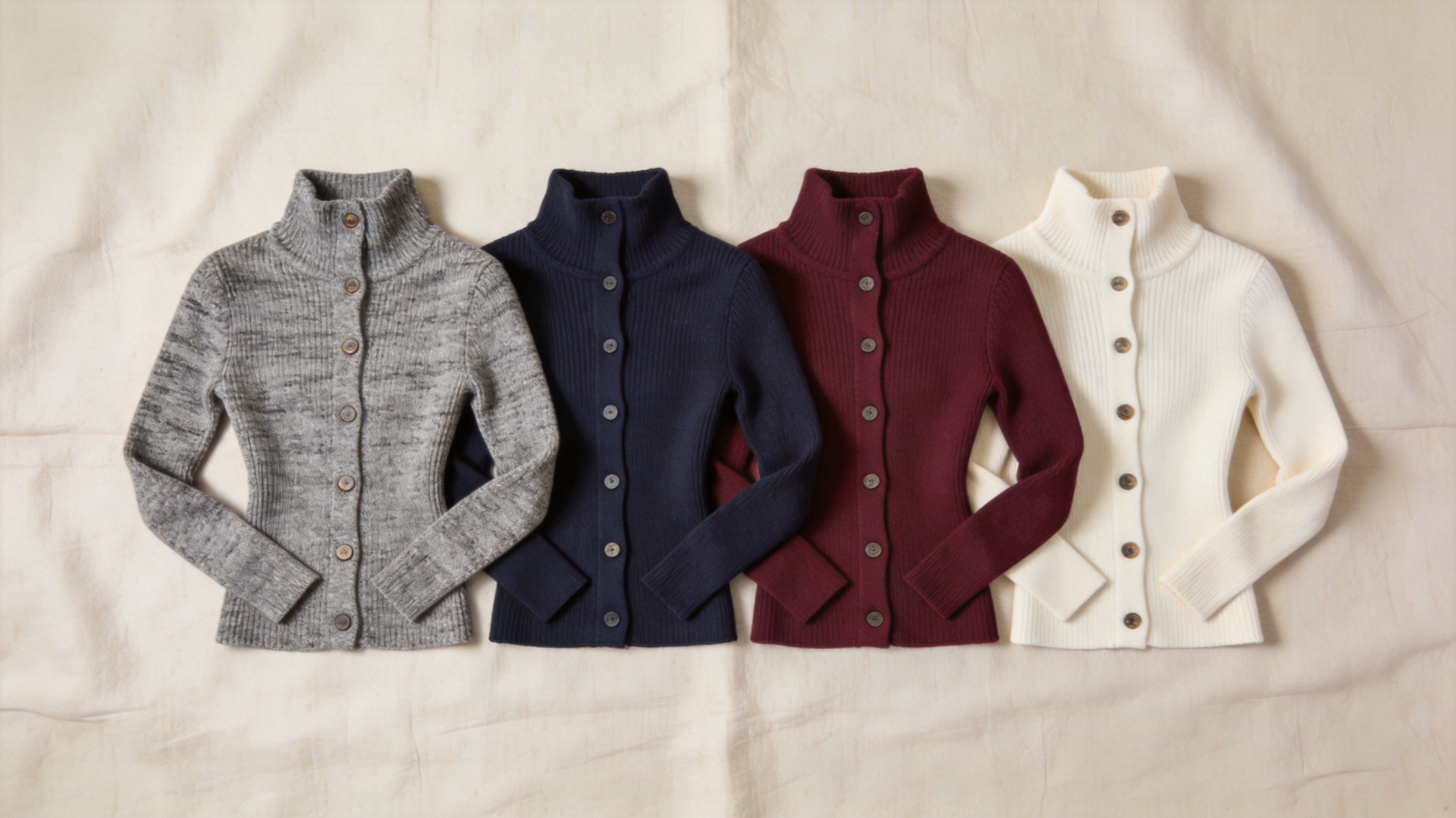
The Fitted Cardigan Comeback: How 90s Minimalism Is Reshaping AW2026 Wholesale Knitwear — A Complete B2B Sourcing Guide
The pendulum has swung. After seasons in which oversized silhouettes, balloon sleeves, and architectural volume dominated every knitwear briefing, the fitted cardigan has made its official return — waist-accentuating, buttoned up, and worn as a top. For buyers searching for a fitted cardigan wholesale B2B partner, this is the cleanest counter-trend opportunity of AW2026: a silhouette the market already understands, re-cut with disciplined modern proportions, validated simultaneously at high-street and premium tiers, and almost completely ignored by existing wholesale sourcing content.
This guide covers the trend evidence behind the comeback, what separates the AW2026 fitted cardigan from the shapeless basics of previous cycles, the three product categories worth buying, the dual-track market logic that pairs fit with volume, fiber recommendations, design specifications, color strategy, merchandising angles, FOB pricing bands, MOQ guidance, and the quality-control checkpoints that determine whether a fitted silhouette survives its first wash.
The Trend Story: From 90s Icons to the 2026 High Street
On October 16, Elle.pl dedicated a full feature to the shift, declaring that "after seasons dominated by sweater oversize, the time has come for the big return of more fitted, waist-accentuating cardigans." Crucially, the feature framed the revival as a nineties story with a structural update: the original minimalist cardigan returns, but finished with high, almost architecturally-shaped collars that pull the silhouette firmly into 2026.
The cultural references are doing real commercial work. The reporting name-checks Jennifer Aniston, Madonna, and Gwyneth Paltrow — the women who made the grey buttoned cardigan a uniform of "apparent simplicity with subtle sensuality and refined pragmatism." That phrase matters for buyers: it describes exactly why the style sells. It looks effortless, reads polished, and requires no styling education from the customer.
Two days earlier, on October 14, Brasil247 confirmed the same correction from the opposite direction: "Oversized sweaters are sharing space in 2026: the new bet is a more fitted silhouette valuing shoulders and waist." Note the wording — oversized is not cancelled, it is sharing space. Fitted cardigans and fine-knit sweaters are redefining winter style alongside the volume trend, not replacing it.
The retail validation is already on the shop floor:
- H&M, Reserved, and Marc O'Polo all stocked fitted, waist-accentuating cardigans the week the story broke — high-street confirmation, not catwalk speculation.
- Grazia Italia (October 15) ranked high-neck cardigans as the #1 of five key knitwear trends for autumn 2026, citing the COS black merino funnel-neck cardigan, a Zara striped high-neck style, and Massimo Dutti cashmere versions.
- Vogue Greece (October 16) reported high turtlenecks and polo knits across the FW26/27 catwalks — the same upward migration of the neckline that defines the updated cardigan.
The styling logic currently circulating in editorial is equally commercial: the cardigan is worn as a top — fully buttoned, nothing underneath — then paired with a pencil skirt for polish, straight jeans and a leather coat for street style, or wide-leg trousers for proportion play. Every one of those formulas sells additional units adjacent to the knit.
What Defines the AW2026 Fitted Cardigan?
Reordering a generic slim cardigan and relabeling it will miss the trend. Four characteristics define the current product.
1. Waist-Defining, Not Tight
The fit values form without constraining it. The silhouette follows the shoulders and waist with light negative ease, but the body is not compressed — this is refinement, not bodycon. In technical terms, that means a shaped side seam and a controlled hem rib rather than elasticated cling, and it is the first thing fit sessions must calibrate.
2. Fine Gauge Instead of Chunky Volume
The fitted cardigan lives at the fine end of the gauge spectrum: 12GG–14GG for the polished classic and second-skin categories, 7GG–9GG for mid-gauge structured styles. Fine gauge is what allows the garment to be buttoned and worn as a top without bulk at the placket, and what makes a high collar stand cleanly instead of collapsing under its own weight.
3. The High, Architectural Collar
The detail that separates 2026 from a literal 90s reissue. Stand collars, funnel collars, and convertible zip collars give the fitted body a structural counterweight and connect the trend to the season's wider neckline story covered in our funnel-neck knitwear sourcing guide. A high collar cardigan B2B program is the single most differentiated buy in this category.
4. Worn as a Top
The styling directive driving the entire revival: buttoned up, nothing underneath. This changes the product brief — plackets must lie flat against skin, buttons must be secure and smooth-backed, and ribbed textures and refined finishes replace the slouchy handfeel of layering cardigans. The garment is judged at blouse standards, not outerwear standards.
Three Categories of Fitted Knitwear
1. The Classic Fitted Cardigan (Button-Front, Fine Gauge)
The commercial heart of the comeback and the primary answer to fitted cardigan wholesale B2B and slim fit cardigan supplier demand. A button-front, fine-gauge body at 12GG–14GG in merino or a cashmere blend, cut cropped-at-waist to high-hip. This is the grey marl 90s hero piece — the lowest-risk, highest-rotation style in the category.
2. The High-Collar Cardigan (Architectural Collar, 90s Updated)
The fashion-forward expression: a fitted body finished with a stand, funnel, or convertible zip collar. It photographs the strongest, carries the clearest editorial narrative, and maps directly onto the COS and Massimo Dutti references validating the trend. Slightly heavier gauges (7GG–9GG) or engineered collar construction give the neckline its architecture.
3. The Second-Skin Knit Top (Fine Rib, Layering Base)
The volume engine: fine rib knits at 14GG that function as the fitted base layer beneath the season's volume pieces. Rib recovery is the entire product here — a second-skin top that bags at the elbow or hem fails immediately. This category feeds fine gauge fitted cardigan manufacturer and ribbed fine-knit queries and reorders fastest at retail.
The Dual-Track Market: Volume AND Fit
The most important commercial insight of Week 47 is that this trend does not cancel last week's. Balloon sleeves, chunky grandpa cardigans, and architectural knits — covered in our architectural knits guide and chunky grandpa cardigan guide — remain confirmed trends with their own retail momentum. Brasil247's framing is exact: oversized is sharing space.
The practical consequence is a dual-track market. Track one is statement volume: dramatic sleeves, oversized bodies, sculptural shoulders. Track two is refined fit: waist-defining cardigans, second-skin ribs, high collars. Buyers need both, because consumers are now merchandising the two against each other — the fitted cardigan is the designated balance piece for volume bottoms, worn buttoned over wide-leg trousers and full skirts, while oversized knits increasingly sit over slim bases.
For range planning, this means the fitted cardigan is not a replacement SKU but an additive one. It gives volume-led assortments their proportion counterweight, gives minimalist customers a way back into knitwear, and gives buyers a second silhouette story to tell in the same delivery window. Retailers who only bought volume in AW2026 now have a documented gap — and 90s style cardigan wholesale supply is the scarcest part of the market.
Materials & Fiber Recommendations
Fiber choice should follow the role of each category. The market evidence points to four practical tiers.
| Fiber | Typical Yarn Count | Character | Retail Position |
|---|---|---|---|
| Extrafine merino wool | 2/48NM–2/60NM | Smooth, refined, holds rib and shape | The workhorse — H&M and Reserved tier |
| Cashmere / cashmere blend | 2/26NM–2/28NM | Soft, light, premium drape against skin | Premium fitted — the Marc O'Polo and Massimo Dutti tier |
| Fine cotton | Nm 16/2–30/2 | Crisp, cool, lighter weight | Accessible and transitional, early-fall delivery |
| Alpaca / yak blends | 2/16NM–2/26NM equivalent | Fluffy, warm, cozy-luxury handfeel | Material story — H&M Premium 35% alpaca, Marc O'Polo yak-alpaca direction |
Fine merino is the default for the classic fitted cardigan: its smooth surface keeps grey marl, navy, and burgundy even and clean, and its natural elasticity supports the waist-defining fit without synthetic content. Cashmere blends serve the premium tier where the cardigan-as-top styling demands a luxurious next-to-skin feel. Fine cotton carries transitional deliveries and price-sensitive markets. Alpaca and yak blends are the season's differentiating material story — the "cozy luxury" fiber shift — and give a fitted cardigan wholesale program a fiber narrative competitors sourcing generic acrylic cannot match. Ribbed constructions, whatever the fiber, should be specified with recovery in mind from the first lab dip. Our yarn selection guide matches counts to end use in detail.
Design Specifications for B2B Buyers
These specifications belong in every tech pack for a fitted cardigan program. Gauge controls how cleanly edges and collars hold; GSM controls whether a fitted body skims or sags.
| Spec | Second-Skin / Fine Rib | Classic Fitted | High-Collar Structured |
|---|---|---|---|
| Gauge | 12GG–14GG | 12GG–14GG | 7GG–9GG |
| Target GSM | 150–220 | 200–280 | 280–360 |
| Primary fibers | Extrafine merino, fine cotton | Merino, cashmere blend | Wool blend, cashmere blend |
| Bust ease | −4 to −2 cm | −4 to 0 cm | −2 to +2 cm |
| Collar | Crew / V | Crew / V, button-front | Stand, funnel, convertible zip |
| Length | Cropped-at-waist | Waist to high-hip | High-hip to hip |
Fit Tolerances & Negative Ease
The "valuing form without constraining" brief translates to roughly 0–4 cm of negative ease at the bust for classic fitted styles, graded consistently across the size run. Because fit is the entire product, measurement tolerance should be tightened to ±1.0 cm on bust, waist, and hem — half the allowance typically given to relaxed knitwear — and every size, not just the sample size, should be measured at pre-production.
Collar Construction
Three collar builds cover the trend: a clean stand collar for the minimalist reading, a funnel collar for the COS-tier look, and a convertible zip collar that wears open as a revere or closed as a funnel. Architectural collars need body — specify a denser collar knit, a doubled construction, or a fine interlining, and require the collar to stand unassisted after washing.
Buttons, Closures & Length
Buttons are the 90s detail that matters. Specify quality shank or sew-through buttons with smooth backs (they sit against skin), reinforced placket attachment, and buttonholes sized to prevent gaping under the slight tension of a fitted body. Length runs cropped-at-waist to hip; the cropped-at-waist version is the most literal 90s reading and pairs hardest with the high-rise, wide-leg bottoms currently driving the dual-track market. The gauge guide explains how knit density affects edge support and shape retention.
Color Strategy
| Color Direction | Mood | Retail Role |
|---|---|---|
| Grey marl | Pure 90s revival, effortless | THE hero color of the comeback — the Elle.pl feature shade and the Aniston-era original |
| Black | The original 90s uniform | Core reorder shade; the cardigan-as-top reads sharpest in black |
| Navy | Classic minimalist | The office workhorse; anchors polished and menswear-adjacent ranges |
| Burgundy | Rich, confident, autumnal | The #1 color for a ninth consecutive week — the fashion anchor of the buy |
| Cream / oatmeal | Soft, quiet luxury | Neutral base for cashmere tiers; shows fine-gauge texture most clearly |
Grey marl should lead the opening buy — it is the color the editorial is actually showing, and the shade most tightly bound to the 90s references driving demand. Black and navy supply the reorderable minimalist core. Burgundy, in its ninth consecutive week at #1, is the lowest-risk fashion shade on the market and connects the fitted story to the season's wider color narrative covered in our color-pop knitwear guide. Cream and oatmeal complete the palette for premium tiers where fiber quality is the selling point.
Styling & Merchandising Angle
The same garment supports four retail narratives, which makes fitted cardigan content unusually strong for lookbooks, Pinterest, and email:
- Buttoned as a top + pencil skirt — the polished look; nothing underneath, heeled or loafed. The hero editorial angle.
- Straight jeans + leather coat — the street-style read; the fitted knit as the sleek base under a structured layer.
- Buttoned + wide-leg trousers — the proportion play; fitted top balancing volume bottom, which is the dual-track market expressed in a single outfit.
- The "effortless chic" formula — fine knit, minimal jewelry, clean hair; the Aniston/Paltrow vocabulary that requires no styling education from the customer.
Merchandise fitted cardigans adjacent to the volume pieces they balance — wide-leg trousers, full skirts, oversized coats — rather than only in the knitwear bay. The neckline story connects naturally to our deep V-neck sourcing guide for buyers building a complete silhouette capsule across both tracks.
Pricing & MOQ Guide
| Product Type | Fiber / Construction | Indicative FOB | MOQ |
|---|---|---|---|
| Cotton fitted cardigan | Fine cotton, 12GG–14GG, ribbed trims | $5–$10 | 200 pcs/color |
| Merino fitted cardigan | Extrafine merino, 12GG–14GG | $7–$14 | 200 pcs/color |
| High-collar structured cardigan | Wool blend, 7GG–9GG, engineered collar | $8–$16 | 200 pcs/color |
| Cashmere blend fitted cardigan | Cashmere blend, fine gauge, button-front | $14–$24 | 200 pcs/color |
The category spans accessible cotton to premium cashmere blends, and standard knitwear markups support healthy retail margins at every tier — a $7–$14 merino fitted cardigan comfortably retails in the high-street smart tier where H&M and Reserved are already validating the shape. The working minimum is 200 pcs per color. A practical first program is three styles — cotton classic in grey marl, merino high-collar in navy or burgundy, and a cashmere-blend piece in cream — creating a complete fitted story in six to nine SKUs.
Quality Control: Fit-First Checkpoints
Fitted cardigan QC concentrates on fit consistency, because the silhouette is the product and failure is visible the moment a customer sizes up or down. Include these checks in your AQL inspection:
- Fit consistency across sizes: measure the full size run against the graded spec at ±1.0 cm; a fitted style that only fits in the sample size is the category's most common failure.
- Rib recovery and shape retention: stretch-and-release tests at cuffs, hem, and placket; ribs must recover fully, and the waist definition must survive the specified wash cycle.
- Button attachment durability: pull-test every button position; plackets must lie flat with no gaping under light tension, and buttonholes must not stretch out.
- Collar structure retention: stand and funnel collars must hold their architecture after washing — check collar density, doubling, and any interlining.
- Dimensional stability: shrinkage within ±3% after wash for fitted styles; shrinkage that tightens the body distorts the intended negative ease.
- Color fastness: grey marl, navy, black, and burgundy require dry and wet crocking at grade 4 minimum, 4–5 for export.
- Pilling and abrasion: ICI pilling at grade 3–4 or better for merino and cashmere-blend tiers worn against skin.
For inspection flow and AQL setup, our knitwear quality-control guide covers the full process, from sampling to final random inspection.
How New Narwhal Can Help
New Narwhal helps buyers capture the fitted cardigan comeback with precision. Based in Taizhou within China's leading knitwear cluster, we operate as knitwear curation and supply-chain specialists, not as a factory. Your gauge, fit, fiber, collar, and price targets are matched to vetted manufacturers genuinely suited to fine-gauge fitted production, rather than forced onto a single volume line.
- Develop classic fitted, high-collar, and second-skin rib programs across cotton, merino, wool blend, and cashmere-blend tiers
- Produce gauge, GSM, yarn-count, negative-ease, collar, and button specifications ready for bulk
- Source fine-gauge workshops with verified fit consistency across full size runs
- Manage sampling, lab dips, rib-recovery and fastness testing, and third-party inspection
- Work within the 200-pcs-per-color minimum and consolidate multi-style orders
Ready to build your fitted cardigan assortment?
New Narwhal helps B2B buyers source the right knitwear, from the right manufacturers, at the right price.
Key Takeaways & Related Sourcing Guides
- The fitted cardigan is the breakout counter-narrative of AW2026. Elle.pl, Brasil247, and Grazia Italia confirm the shift; H&M, Reserved, Marc O'Polo, and COS already stock it.
- The update is structural, not nostalgic: waist-defining fit, fine 12GG–14GG gauges, and high architectural collars separate 2026 from a literal 90s reissue.
- The market is dual-track: volume and fit run in parallel, and the fitted cardigan is the balance piece every volume-led assortment now needs.
- FOB pricing runs from $5 for cotton to $24 for cashmere blends, with 200 pcs per color as the working MOQ.
- Grey marl leads, burgundy holds #1 for a ninth week, and QC must be fit-first — size-run consistency, rib recovery, button durability, and collar retention before bulk ships.
Related sourcing guides:
- Argyle & Fair Isle Knitwear: The Haute Heritage Pattern Boom of AW2026 — B2B Sourcing Guide — this week's companion pattern story, including heritage cardigans
- Architectural Knits & Balloon Sleeves: The AW2026 Volume Revolution — B2B Sourcing Guide — the volume track of the dual-track market
- Deep V-Neck Knitwear: The AW2026 Revival — B2B Sourcing Guide — neckline specifications for the layering wardrobe
- Funnel-Neck Knitwear: The Dominant Silhouette — B2B Sourcing Guide — collar construction adjacent to the high-collar cardigan
- Chunky Knit Grandpa Cardigans — B2B Sourcing Guide — the oversized cardigan track that shares the season
- Color-Pop Knitwear: The Bold Color Revolution — B2B Sourcing Guide — the color foundation for burgundy-led ranges
- Sourcing Knitwear in the Taizhou Cluster — how the supply base behind this category works