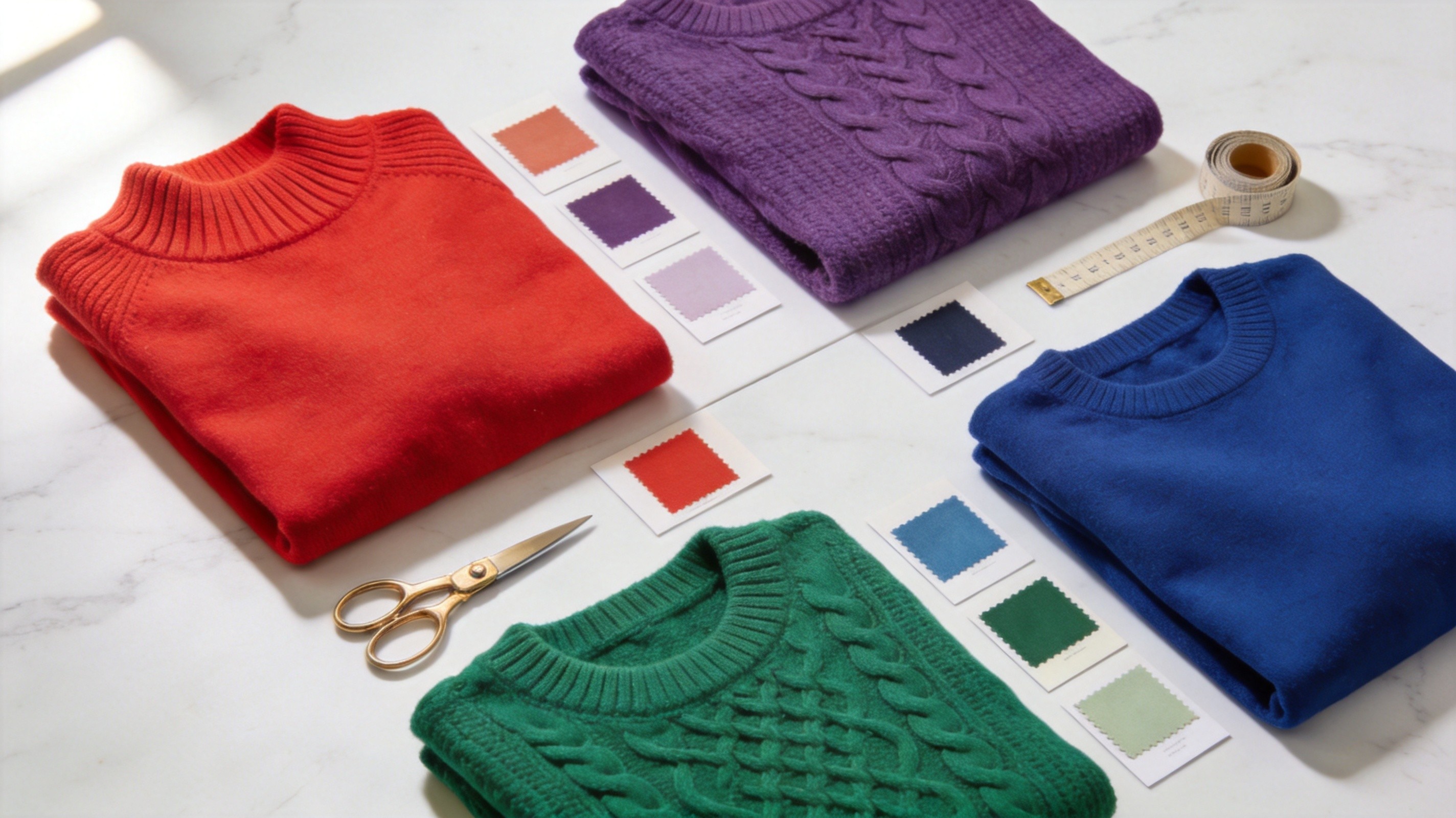
Color-Pop Knitwear: The Bold Color Revolution Reshaping B2B Sourcing for AW2026
For three autumns, the industry playbook was simple: buy burgundy, chocolate, camel, and cream, and wait for them to sell through. The AW2026 season has just torn that playbook up. In the final week of September 2026, the industry's most influential retail and editorial voices converged on a single message — colorful knitwear is no longer an accent story; it is the headline story.
NET-A-PORTER opened the week of September 22 with a dedicated feature titled "Trending Now: Color-Pop Knits," declaring officially that "colorful knitwear is having a moment." The four hues it named — fire-truck red, shamrock green, cobalt blue, and royal purple — read less like a seasonal palette and more like a manifesto. COS built its entire autumn 2026 knitwear position around a bright "Veronica Purple," while M&S launched a "Red alert" edit of bold block-color cashmere and merino.
This is the biggest color shift in knitwear in more than three years. It is also a sourcing moment with almost no B2B educational content around it. Wholesale buyers searching for a colorful knitwear supplier currently find consumer trend lists and generic marketplace pages — not a structured sourcing guide. This guide fills that gap: the four hero colors, the supporting accents, material and gauge choices, a B2B color-assortment strategy, FOB pricing, MOQ guidance, and the quality-control points that separate a credible bold-color program from a markdown program.
The Trend Story: From Runway Declaration to Retail Commitment
What makes this color cycle unusual is the speed and unanimity of validation. Within five days in late September 2026, four distinct tiers of the market — luxury e-commerce, contemporary design retail, premium mass, and fashion press — all moved in the same direction.
- NET-A-PORTER (September 22): A comprehensive color-pop knits feature identified four trending hues — fire-truck red, shamrock green, cobalt blue, and royal purple — and noted that a red knit has been the fashion set's secret styling trick for several seasons. When the industry's leading luxury marketplace devotes a dedicated edit to a category, it means the sell-through data already supports it.
- COS (September 22): COS's autumn 2026 knitwear report named funnel-neck knitwear one of its five major trends and made "Veronica Purple" the hero color — appearing on a bright purple merino high-neck and a cashmere funnel-neck. Forest green ran as a secondary color story across the same collection.
- M&S (September 21): The British retailer's autumn knitwear guide led with "Red alert" bold block-color cashmere and merino, while merchandising candy floss, rose, and dusky pink as a grown-up pink palette. This is the signal that matters for volume: bold color crossing into mainstream premium retail.
- Vogue UA (September 21): Its AW2026/27 runway roundup placed juicy red, deep burgundy, electric blue, sunny yellow, and fresh chartreuse among the defining colors of the season.
- W Magazine (September 26): Its covetable cashmere report connected structural knitwear details with vibrant color, confirming the premium end of the trend.
The Four Hero Colors for AW2026
These four colors have earned full-line status. Each was independently named by multiple authoritative sources in the same week, and each works across cardigans and pullovers.
1. Fire-Truck Red: The Fashion Set's Proven Weapon
Fire-truck red ranks first in the updated AW2026 palette. NET-A-PORTER's phrasing matters commercially: a red knit has been the fashion set's secret styling trick for several seasons, which means the color carries trend credibility without trend risk. M&S turned the same signal into a "Red alert" retail edit in cashmere and merino — the materials that carry red with the most depth.
For B2B buyers, red is the lowest-risk bold color in the assortment. It layers over denim, anchors tonal tailoring, and photographs strongly for e-commerce and social. The extension from six weeks of burgundy dominance into a brighter red is a natural step-up buy for customers already trained on wine tones.
2. Royal Purple: The Dominant Runway Color
Royal purple is the season's most-decisive fashion statement. Purple was identified as the dominant color trend on the FW2026 runways, with Aimee Song spotted in a purple knit, and a LOEWE royal purple wool sweater priced at €980 already selling out. COS translated the signal for the contemporary tier with "Veronica Purple" on a bright merino high-neck and a cashmere funnel-neck.
Purple's B2B value is differentiation. Few competitors carry it with depth, yet the runway validation is stronger than for any other hue. Buyers should treat purple as a signature color — one or two hero silhouettes in merino or cashmere, merchandised as the collection's point of view rather than buried among basics.
3. Shamrock and Forest Green: The Unexpected Zing
Green is the surprise of the season. NET-A-PORTER described shamrock green as an "unexpected zing," while COS carried forest green as a full secondary color story — including a forest green funnel-neck half-zip that aligns with two trends at once. Green is also being positioned as a timeless alternative to black and brown, which gives it longer shelf life than a typical novelty color.
Green works hardest in texture: cashmere, merino, and cable constructions hold the depth that keeps the color rich rather than costumey. It pairs naturally with cream, denim, and the burgundy tones already in most customers' wardrobes, reducing the styling barrier at retail.
4. Cobalt Blue: Vivid Intensity for Statement Knitwear
Cobalt blue — electric blue on the runways — brings the season's sharpest intensity. Both NET-A-PORTER and the Vogue UA runway roundup validated it, with the watch-list note calling out its "vivid intensity." Cobalt is the cleanest, most graphic color in the palette and the strongest option for fine-gauge, minimalist silhouettes where the color itself is the design.
For buyers building a color-pop offer, cobalt is the recommended second bold after red. It appeals to customers who want a statement color without the sweetness of pink or the drama of purple, and it performs exceptionally in merino and cotton-blend constructions.
Accent Colors That Earn Floor Space
The hero four deserve depth; the following three deserve targeted buys. They extend the collection's trend authority and support add-on sales without requiring large commitments.
Chartreuse: Trending for a Second Consecutive Fall
Chartreuse is the rare accent with a proven repeat cycle. Reporting on September 21 confirmed that chartreuse sweaters are trending for the second fall in a row, noting that the warm pop of color makes a piece feel special. It also works as a complement to the earthy browns and wines already dominating knitwear floors. Recommended placement: one chunky cardigan or one cashmere-blend pullover, positioned as the collection's fashion-forward edge.
Candy Floss and Dusky Pink: Grown-Up Pink Goes Mainstream
M&S explicitly merchandised candy floss, rose, and dusky pink as a grown-up pink palette — the post-Barbie, mature version of the color. Dusky pink carries particularly well in fine-gauge merino and cashmere blends, where it reads as soft luxury rather than novelty. It is the strongest bold-adjacent color for customers who want to experiment without committing to red or cobalt.
Sunny Yellow: The Brightness Pop
Sunny yellow appeared in the Vogue UA AW2026/27 runway roundup as a primary pop of brightness. Its commercial role is small but clear: one or two pieces lift a flat lay, energize a retail wall, and photograph strongly for social and Pinterest. Keep yellow to accessories of the assortment — a cotton cardigan or a merino pullover — rather than a depth color.
Materials and Construction for Color-Pop Knitwear
Bold color changes the material equation. In a neutral, a decent yarn looks acceptable; in fire-truck red or royal purple, yarn quality and construction are visible at three metres. The table below sets out the specifications buyers should put into an inquiry or tech pack.
| Construction Tier | Gauge | Typical Yarn Count | Target GSM | Recommended Fibers | Color Role |
|---|---|---|---|---|---|
| Fine-gauge | 12GG | Merino 2/48NM–2/60NM; cotton Nm 12/2–16/2 | 150–210 | Extrafine merino, mercerized cotton, cashmere blends | Cobalt, purple, dusky pink — graphic, polished |
| Mid-gauge | 7GG–9GG | Cotton Nm 8/2–10/2; cashmere 2/26NM–2/28NM | 220–300 | Merino, cashmere, cotton-wool blends | Red, forest green — the volume color-pop tier |
| Chunky | 3GG–5GG | Wool-blend or cashmere-blend roving | 300–420 | Wool blends, brushed cashmere, wool-acrylic | Chartreuse, red — statement textural pieces |
Cashmere for Luxury Color Impact
Cashmere takes deep jewel tones with a softness and depth that no other fiber matches — the basis for W Magazine's covetable cashmere story and COS's cashmere funnel-neck in Veronica Purple. It is the correct choice for a premium signature piece, and it justifies the top of the FOB range. Request grade-A white cashmere before dyeing; grey or yellow base fibers dull vibrant tones.
Merino Wool for Accessible Vibrancy
Extrafine merino is the workhorse of the color-pop category. It accepts reactive dyes cleanly, holds red and cobalt with excellent clarity, and lands at a price point that supports volume. COS's bright purple merino high-neck demonstrates how much fashion impact a well-dyed merino can carry. A 2/48NM merino at 9GG–12GG is the safest specification for a first bold-color order.
Cotton Blends for Transitional Color
Cotton and cotton-rich blends make color-pop knitwear viable in early fall and mild-winter markets. Mercerized cotton carries cobalt and red with a slight sheen, while cotton-wool blends add warmth for deeper winter. Cotton is also the most forgiving fiber for care, which reduces returns in less mature knitwear markets.
Color Strategy for B2B Buyers
A trend is not an assortment. The commercial challenge of color-pop knitwear is committing enough to look authoritative while protecting open-to-buy from colors customers may not yet be ready to wear. The following framework converts the trend into an order plan.
Core-to-Bold Ratio: The 60/40 Assortment
For AW2026, a recommended knitwear split is roughly 60% core tones (burgundy, chocolate, camel, black, cream) and 40% bold tones (the four hero colors plus one chosen accent). This is materially bolder than the 80/20 or 90/10 split of recent seasons, but it is defensible: burgundy remains strong for a sixth week, while red, purple, green, and blue are now independently validated as headline colors. Conservative buyers can enter at 70/30 and test-reorder into winners.
Minimum Color Assortment
A credible color-pop edit needs at least four bold colors to read as a story rather than a mistake buy. The recommended entry assortment is red and cobalt as depth colors, purple as the signature fashion piece, and green as the textural option — with chartreuse or dusky pink as a single accent. One bold color alone on a neutral floor reads as leftover stock; four colors together read as a curated trend edit.
MOQ and Dye-Lot Reality
The standard minimum order for this category is 200 pieces per color. That means a four-color bold program begins at roughly 800 pieces across one or two styles — accessible to most wholesale buyers, but it rewards concentration. Instead of ordering six colors in one style at shallow depth, order four colors across two complementary silhouettes (a cardigan and a pullover), which doubles merchandising flexibility without doubling SKU count.
Pricing and MOQ Guide
The trend analysis for this category indicates an overall FOB band of $8–$25 at a 200-piece MOQ. The indicative tiering below sits within that band and varies with fiber, gauge, and construction complexity. Prices move upward for cashmere content, intarsia or multi-color patterning, and hardware such as zips.
| Product Type | Fiber / Construction | Indicative FOB | MOQ | Suggested Depth |
|---|---|---|---|---|
| Cotton color-pop cardigan | Mercerized cotton, 9GG–12GG | $8–$12 | 200 pcs/color | Red, cobalt |
| Merino vibrant pullover | Extrafine merino, 7GG–12GG | $10–$18 | 200 pcs/color | All four hero colors |
| Cashmere color statement piece | Grade-A cashmere, 7GG–9GG | $16–$25 | 200 pcs/color | Purple, red, green |
| Multi-color / intarsia collection | Merino or cotton blend, color-blocked | $10–$22 | 200 pcs/style | One or two hero styles |
Retail markups in knitwear typically run 3x–4.5x FOB depending on channel and brand positioning, so the FOB band above supports a wide range of retail price architectures — from accessible color-pop cotton to luxury cashmere statements.
Quality Control for Bold Colors
Bright colors fail differently from neutrals. A neutral can survive a moderate fastness miss; a red or purple cannot — it transfers onto a customer's shirt or hands and becomes a return plus a review problem. Build these checkpoints into every bold-color PO.
- Color fastness to crocking: Non-negotiable for fire-truck red and royal purple. Test both dry and wet crocking; require a minimum grade 4 for general markets and grade 4–5 for export-quality programs. This is the single most important test in the category.
- Washing and perspiration fastness: Require grade 4+ across color change and staining. Deep reds and purples are prone to bleed in the first washes, particularly in cotton-wool blends where fibers accept dye differently.
- Dye-lot consistency: Approve a sealed lab dip before bulk; compare finished bulk garments against the approved standard under a D65 light source. Reject lots that drift beyond the agreed tolerance — the cost of reworking is lower than the cost of mismatched floor sets.
- Shrinkage control in multi-fiber blends: Cotton-wool and wool-acrylic blends respond differently to finishing. Require dimensional stability within ±5% after the agreed wash cycle, and confirm garments are fully relaxed and pressed before packing.
- Pilling resistance across color families: Pilling shows more on bold colors because loose surface pills catch the light differently from the base knit. Request ICI pilling box results at grade 3–4 minimum for merino and cashmere blends.
- Shade continuity in trims: Buttons, zips, and twill tapes must be matched to the dyed garment. A navy button on a cobalt cardigan undermines the entire color story; specify trims from the same dye program or approve them against the bulk shade.
For a deeper framework, our knitwear quality-control guide covers AQL inspection setup, and the gauge guide explains how knit density changes both look and performance.
How New Narwhal Can Help
Color-pop knitwear is the breakout story of AW2026 — and New Narwhal is positioned to help buyers build a credible bold-color program from the first sample. Based in Taizhou, the heart of China's knitwear cluster, we work as knitwear curation and supply-chain specialists rather than as a single factory. That independence lets us match your color and price objectives to the right vetted manufacturer instead of fitting every order to one production line.
- Build four-color hero assortments and 60/40 core-to-bold order plans around real-time trend data
- Source cotton, merino, and cashmere color-pop programs across the full $8–$25 FOB band
- Prepare tech packs with gauge, yarn count, GSM, and trim specifications ready for production
- Manage lab dips, dye-lot control, and third-party fastness and pilling testing
- Support sampling, MOQ negotiation, and consolidation at a 200-pcs-per-color minimum
Ready to add bold color to your AW2026 knitwear buy?
New Narwhal helps B2B buyers source the right colorful knitwear, from the right manufacturers, at the right price.
Related Sourcing Guides
- Funnel-Neck Knitwear: The Dominant Silhouette — B2B Sourcing Guide — the structural trend that pairs with bold color, including the forest-green half-zip that hits both trends at once
- Imperial Red Knitwear: The FW2026 Color Strategy — the deep red foundation that fire-truck red extends
- Funnel-Neck and Turtleneck Cardigans: AW2026 Sourcing Guide — neckline construction specifications
- Knitwear Yarn Selection Guide — choosing the fiber that holds your color
- Sourcing Knitwear in the Taizhou Cluster — how the supply base behind this category works
Key Takeaways for B2B Buyers
- Color-pop is the breakout story of AW2026. NET-A-PORTER, COS, M&S, Vogue, and W Magazine all validated bold knitwear color in the same week — the biggest shift in 3+ years.
- Four colors lead: fire-truck red, royal purple, shamrock green, and cobalt blue. Chartreuse, dusky pink, and sunny yellow play supporting roles.
- Move toward a 60/40 core-to-bold split. Enter with four bold colors across two silhouettes at 200 pieces per color.
- FOB runs $8–$25 from cotton cardigans to cashmere statements, with dye-lot and fastness control deciding program quality.
- B2B sourcing guidance for this category is almost nonexistent. Early movers get to define bold knitwear in their markets.