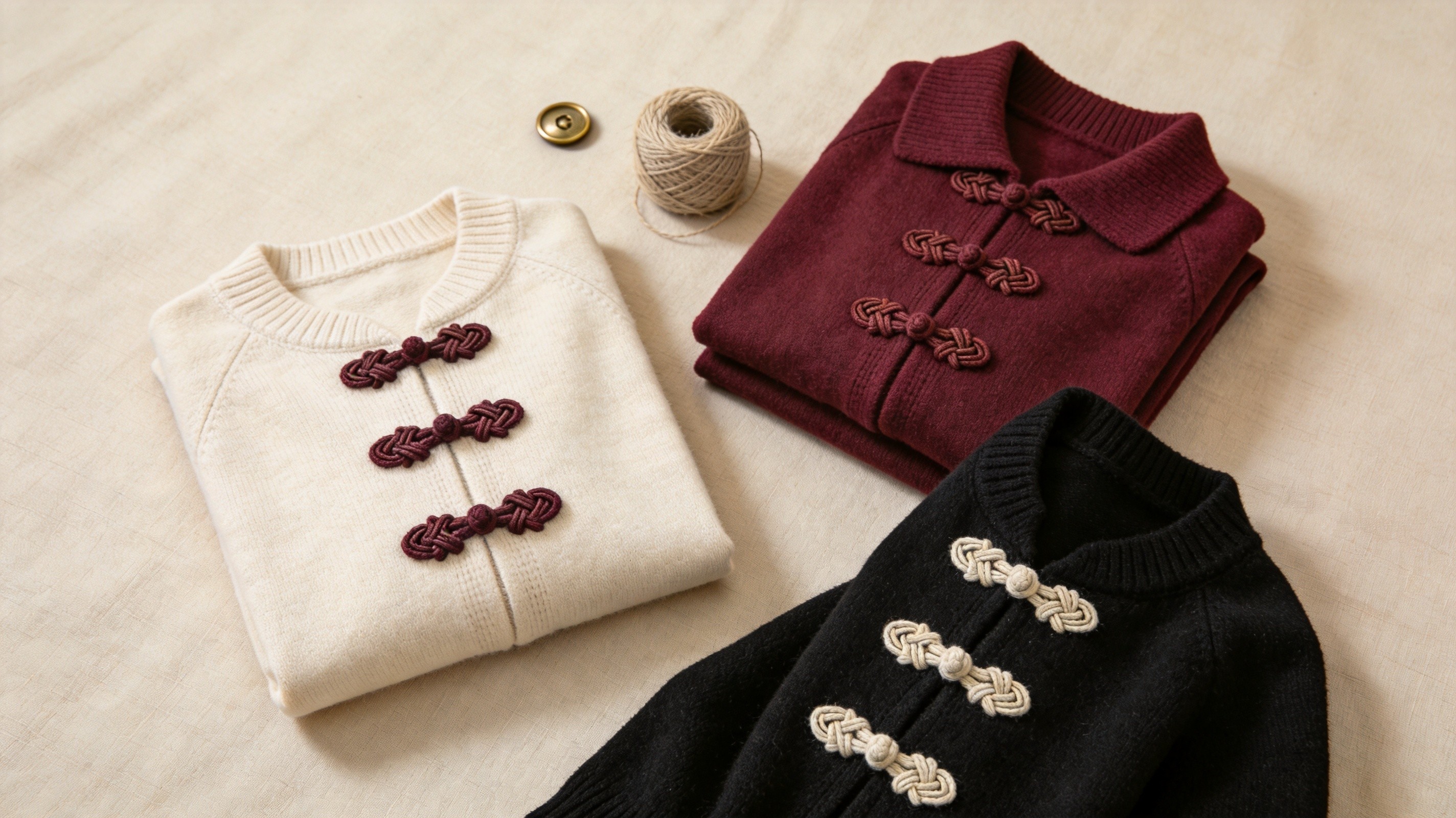
Frog Fastening Cardigans: The Breakout Closure of AW2026 — A B2B Sourcing Guide
The most important knitwear detail of AW2026 is not a new silhouette or a new shade. It is a closure. As Daily Times 247 reported in its September 30 trend feature, "the humble cardigan is getting a quietly elegant update," with ornamental frog fastenings "giving even the simplest autumn outfits a decidedly more polished feel." Zara's frog-fastening cardigan was already selling out within weeks of launch, and the same detail was appearing across Mango, Massimo Dutti, Róhe, H&M, Bershka, ASOS, Urban Outfitters, Selected, and Mint Velvet — a span from value high street to luxury contemporary that almost no single detail achieves in one season.
For wholesale buyers searching for a frog fastening cardigan wholesale B2B partner, the practical question is how to source this detail correctly. A frog fastening — also called a pankou knot or Chinese frog closure — is a hand-braided cord knot-and-loop fastener, traditionally made from woven ribbon or self-fabric cord. Despite the name, it contains nothing amphibian: the "frog" is the knotted button, and the soft loop it passes through is its partner. The technique has centuries of heritage in Chinese tailoring, which is exactly why it elevates a basic cardigan into something that reads considered, artisanal, and premium.
This guide explains the trend evidence, how frog closures are constructed, the three cardigan categories buyers should know, fiber and specification recommendations (gauge, GSM, knot size, spacing), color strategy, FOB pricing bands and MOQ, and the quality-control points that separate a closure that lasts from one that fails after a season.
The Trend Story: From Jacket Trims to Knitwear
Frog fastenings did not arrive in knitwear overnight. The crossover trajectory documented across the past year is clear, and it is the same path taken by many details that become lasting categories: "first spotted on jackets last winter, then linen blouses in summer — now knitwear." Each step moved the fastening toward softer, more everyday garments, and each step widened the audience that recognized it.
Three signals make the AW2026 moment different from earlier appearances:
- A genuine sellout, not just a runway look. Zara's frog-fastening cardigan sold through at retail speed — the strongest possible validation that consumers, not only editors, want the detail. High-street sellouts predict bulk demand more reliably than catwalk coverage because they represent completed purchases.
- Luxury obsession that sets the quality ceiling. Róhe's wool-cashmere frog-fastening jacket became the piece that fashion followers were described as "obsessed" with, establishing the premium template: restrained body, luxurious fiber, knots treated as the sole decoration. When a contemporary luxury brand builds desire around a closure, mid-market versions inherit the story at accessible prices.
- Fashion-month visibility. Influencer Debora Rosa was spotted in a frog-fastening cardigan during the fashion-month circuit, carrying the trend from showrooms directly into street-style imagery — the channel that drives consumer search within days rather than seasons.
What Is a Frog Fastening? A Construction Guide for Buyers
A Knot-and-Loop Closure — Not an Amphibian
A frog fastening is a two-part closure. One side carries a frog: a decorative button formed by braiding, folding, and stitching cord into a compact knot — traditionally the pankou of Chinese dressmaking, where knot shapes carried symbolic meaning. The other side carries a loop (sometimes called the nest or eye): a matching soft ring anchored to the garment through which the frog is pushed. The mechanism is entirely mechanical — friction and the knot's shape hold it closed — so performance depends on knot firmness, loop elasticity, and secure attachment rather than on any hardware.
For product pages and retail training, the useful synonyms are Chinese frog closure, pankou knot, knot fastening, and (for simplified versions) toggle fastening. Using several of these terms in your own copy captures the different ways consumers and buyers search for the same product.
Traditional Frogs vs. Modern Adaptations
- Hand-braided woven knots: The classic construction. Narrow woven tape or tubular cord is folded and hand-stitched into floral, ball, or figure-eight shapes. Highest craft content, highest perceived value, and the version closest to the Róhe luxury template. Labor content is meaningful and should be reflected in costing.
- Self-fabric or covered-cord frogs: Cord is wound from the same yarn or fabric as the cardigan, giving a tonal, minimalist look. Excellent for premium fine-gauge merino and cashmere styles where contrast trim would feel too literal.
- Molded toggles and toggle hybrids: Horn-effect, resin, wooden, or leather toggles paired with knitted or corded loops. More durable in heavy use, faster to produce, and the most masculine-leaning, casual option. Toggle hybrids are the right call for jacket-shaped and chunky cardigans.
- Fabric-only loops: Some streamlined designs use a fabric-covered bar button with an ornamental loop — decorative in silhouette but faster and lower-priced to produce. A useful option for opening price points.
Placement: Where the Detail Sits Changes the Garment
- Center-front row: The standard cardigan read — three to five knots spaced evenly from collar to hem. Safest for volume orders and the easiest to QC.
- Asymmetric placement: A single statement knot at a wrap crossover or diagonal placket. Reads modern and editorial; the attachment carries more load because it is the only closure, so reinforcement is essential.
- Mandarin collar framing: One knot secures a stand collar at the throat, with optional additional knots below. This is the most polished, heritage-tailoring expression and supports the highest price multiple.
Three Categories of Frog Fastening Cardigans
1. Classic Frog Knot Cardigan (Traditional, Ornamental)
The pure trend piece: a fine-to-mid gauge cardigan whose only decoration is a row of hand-braided pankou knots and matching loops. Closest to the Zara and Róhe references, it suits elevated everyday assortments and boutique buyers looking for an elegant detail cardigan manufacturer. Expect the handwork to dominate the trim cost; keep the body simple so the knots remain the focal point.
2. Toggle/Button Hybrid Cardigan (Modern, Functional)
A contemporary interpretation pairing molded horn, wood, or resin toggles with knitted loops — sometimes mixed with concealed inner buttons for security. This is the category behind most toggle cardigan wholesale B2B demand: it performs like outerwear, survives heavy wear better than pure cord knots, and works across casual, unisex, and masculine-leaning ranges. It also scales more easily into volume because less hand labor is required per piece.
3. Mandarin Collar Frog Cardigan (Structured, Polished)
A structured stand collar fastened by a single frog, optionally extended into a two- or three-knot front. This is the most explicit nod to the closure's tailoring heritage and the most office- and occasion-ready version. It photographs beautifully, styles cleanly over tailored bottoms, and earns the strongest premium in a multi-tier collection. Specify double-knit or interfaced collars so the stand survives repeated fastening.
Fibers & Yarn Recommendations
The fastening should drive the fiber choice, not the reverse. Delicate hand-braided knots need a smooth body yarn with enough structure to anchor stitching; chunky toggles pair naturally with heavier, textured bases.
| Fiber | Typical Yarn Count | Character | Best Closure Match | Position |
|---|---|---|---|---|
| Extrafine merino wool | 2/48NM | Smooth, refined, takes color cleanly | Classic frog knots, tonal self-cord | Premium — the versatile default |
| Cashmere / cashmere blend | 2/26NM–2/28NM | Soft, luxe, light relative to warmth | Fine hand-braided knots, mandarin collar | Luxury — Róhe template |
| Mercerized cotton | Nm 8/2–16/2 | Crisp, cool, transitional | Fabric loops, covered-cord frogs | Accessible, early-fall delivery |
| Wool-alpaca blend | Roving to 2/20NM | Textured, fuzzy, warm | Toggle hybrids, larger knots | Casual / chunky versions |
Merino is the workhorse for colorful frog-fastening programs because deep and bright shades read evenly on its smooth surface. Cashmere and wool-cashmere blends belong at the luxury tier, where the closure's handwork and the fiber's softness reinforce each other. Cotton is the correct choice for transitional deliveries in milder markets and for price-sensitive ornamental button cardigan supplier programs. Wool-alpaca supports the heavier, more casual end of the category — worth developing if your market also buys chunky knits, covered in our companion chunky-knit grandpa cardigan sourcing guide.
Design Specifications for B2B Buyers
These specifications belong in every tech pack for a frog-fastening program. Gauge controls how cleanly the placket supports the knots; GSM controls whether the body drapes or pulls under their weight.
| Spec | Fine / Polished | Mid / Versatile | Casual / Chunky |
|---|---|---|---|
| Gauge | 10GG–12GG | 7GG–9GG | 5GG–7GG |
| Target GSM | 180–260 | 240–320 | 320–450 |
| Primary fibers | Merino, cashmere blends | Merino, cotton blends | Wool-alpaca, wool blends |
| Closure | Hand-braided pankou knots | Classic knots or self-cord frogs | Horn/wood toggles, knitted loops |
| Collar | Mandarin, crew, slim shawl | Crew, shawl | Shawl, stand, collarless open |
| Placket | Tonal self-fabric, clean-finished | Self-fabric or narrow contrast | Wider, jacket-style |
Frog Size and Spacing
- Knot diameter: 1.5–2.5 cm (0.6–1") on fine-gauge bodies; up to 3–4 cm (1.2–1.6") on chunky and toggle versions. Oversized knots on lightweight knits pull the placket and distort the hem.
- Number and spacing: Four fastenings is the commercial sweet spot for a standard 55–60 cm cardigan, spaced 9–12 cm apart; three larger knots read more modern and editorial; five reads traditional and heritage.
- Anchor construction: Every knot and loop must be stitched through a reinforced placket — twill tape or self-fabric binding behind the knit — never onto a single jersey layer, which will ladder under pull.
- Loop tension: Loops should hold the frog with light friction but release without a hard tug. Over-tight loops are the most common reason customers stop using the closure and wear the cardigan open.
Collar Options
Crew necks keep the look modern and everyday; shawl collars add heritage warmth and pair naturally with larger knots; mandarin collars deliver the structured, polished expression that justifies premium pricing. The collar choice should match the knot style — mixing a traditional pankou row with a slouchy casual collar confuses the design story.
Color × Fastening Combinations
Tonal knots on a matching body deliver the quiet-luxury read and are the safest premium choice. Contrast knots — black on cream, camel on pearl grey — make the detail visible from distance and perform best in e-commerce imagery and social content. Burgundy bodies with tonal or gold-tone knots align two trends at once, since burgundy is now appearing directly in frog-fastening styles.
Color Strategy for AW2026
| Color Direction | Mood | Fastening Treatment | Retail Role |
|---|---|---|---|
| Pearl grey / cream / ivory | Classic, elegant, quiet luxury | Tonal or self-cord knots | Hero depth color — the Zara sellout direction |
| Burgundy / oxblood | Rich, autumnal, polished | Tonal knots or gold-tone cord | #1 accent for a seventh consecutive season, now in frog styles |
| Black | Versatile, party-ready, sleek | Black or jet tonal knots | Occasion and evening crossover |
| Brown / camel | Warm, heritage, tailored | Horn toggles or leather-cord frogs | Massimo Dutti wool-blend direction; volume neutral |
Pearl grey and cream should be the depth colors in any opening order — they are the shades in which the detail reads most clearly and which carried the Zara sellout. Burgundy adds the season's strongest proven accent with seven weeks of continuous demand behind it. Black extends the piece into the Q4 occasion and party season. Brown and camel anchor the heritage, toggle-led end of the range and pair naturally with horn hardware.
Pricing & MOQ Guide
| Product Type | Fiber / Construction | Indicative FOB | MOQ | Retail Role |
|---|---|---|---|---|
| Cotton frog-fastening cardigan | Mercerized cotton, 7GG–10GG, covered-cord knots | $6–$12 | 200 pcs/color | Accessible, transitional |
| Merino toggle cardigan | Extrafine merino, 7GG–12GG, knots or toggles | $8–$16 | 200 pcs/color | Premium volume hero |
| Wool-alpaca toggle hybrid | 5GG–7GG, horn/wood toggles | $9–$17 | 200 pcs/color | Casual chunky crossover |
| Cashmere frog-detail cardigan | Cashmere blend, fine hand-braided knots | $15–$28 | 200 pcs/color | Luxury signature piece |
The overall trend band sits at roughly $7–$20 FOB across the market; the table reflects how fiber and handwork move a style within and around that band. With standard knitwear markups of 3x–4.5x FOB, the category supports everything from accessible cotton pieces to investment cashmere. A practical first order is three styles — cotton, merino, cashmere blend — across two colors each, which creates a visible frog-fastening sub-category at modest SKU spread.
Quality Control: Closure-First Checkpoints
Frog-fastening QC concentrates at the trim and its attachment — the failure points that turn an elevated cardigan into a disappointing one. Include these checks in your AQL inspection:
- Knot integrity and pull strength: Each braided knot must be tight, uniform, and sealed so it cannot unravel. Pull-test knots and loops to a defined force; loose knots loosen further in wash and wear.
- Fastening cycle testing: Fasten and release each closure 50+ times during inspection sampling. Loops must retain tension and knots must keep shape — closures that sag after cycling are a fail.
- Attachment reinforcement: Confirm stitching passes through reinforced placket backing (twill tape or self-fabric binding), not single-layer knit. Check the reverse of every fastening for skipped stitches.
- Alignment and spacing consistency: Knots must align exactly with loops when worn; misalignment forces strain onto one side. Measure spacing against the tech pack — hand placement drifts between operators.
- Color fastness around trim: Deep shades (burgundy, black, brown) risk crocking and transfer at knot and loop contact points. Require dry and wet crocking at grade 4 minimum, 4–5 for export.
- Pilling and abrasion: Knots rub against loops continuously; merino and cashmere bodies need ICI pilling results at grade 3–4 or better.
- Dimensional stability: Require shrinkage within ±5% after the specified wash; plackets that tighten cause loops to misalign after the first laundering.
- Handwork consistency: On fully hand-braided programs, sample multiple workers before bulk — knot size and shape variation is the single most visible defect on a detail-led garment.
For inspection flow and AQL setup, our knitwear quality-control guide covers the full process; the gauge guide explains how knit density affects placket support, and the yarn selection guide matches fibers to closure type.
How New Narwhal Can Help
Frog fastening is the breakout closure of AW2026 — and New Narwhal helps buyers source it with precision. Based in Taizhou within China's leading knitwear cluster, we operate as knitwear curation and supply-chain specialists, not as a factory. Your knot styles, fiber choices, and price targets are matched to vetted manufacturers genuinely suited to them, rather than forced onto a single production line.
- Develop classic frog-knot, toggle-hybrid, and mandarin-collar programs across the full FOB band
- Produce gauge, GSM, yarn-count, knot-size, spacing, and reinforcement specifications ready for bulk
- Source hand-braided pankou workshops and toggle hardware with verified consistency
- Manage sampling, lab dips, cycle and pull-strength testing, and third-party fastness inspection
- Negotiate around the 200-pcs-per-color minimum and consolidate multi-style orders
Ready to build your frog-fastening cardigan assortment?
New Narwhal helps B2B buyers source the right knitwear, from the right manufacturers, at the right price.
Related Sourcing Guides
- Chunky-Knit Cardigans & Grandpa Knit: The Heritage Revival — B2B Sourcing Guide — the companion heavy-gauge trend, including toggle-led wool-alpaca styles
- Color-Pop Knitwear: The Bold Color Revolution — B2B Sourcing Guide — the color foundation for statement frog-fastening pieces
- Funnel-Neck Knitwear: The Dominant Silhouette — B2B Sourcing Guide — neckline and collar construction specifications
- Sourcing Knitwear in the Taizhou Cluster — how the supply base behind this category works
Key Takeaways for B2B Buyers
- Frog fastenings are the breakout closure of AW2026. A Zara sellout, Róhe obsession, and a nine-brand high-street sweep validate the detail across every price tier.
- A frog is a hand-braided pankou knot, not an animal. Specify knot construction, loop tension, and reinforced attachment explicitly in every tech pack.
- Three categories cover the market: classic frog knot, toggle hybrid, and mandarin collar — build one style in each for a complete opening assortment.
- FOB pricing runs roughly $6–$28 across cotton, merino, wool-alpaca, and cashmere tiers, with 200 pcs per color as the working MOQ.
- Pearl grey and cream are the hero colors, with burgundy, black, and brown/camel completing the range — QC knot pull, cycle life, and trim-area fastness before bulk ships.