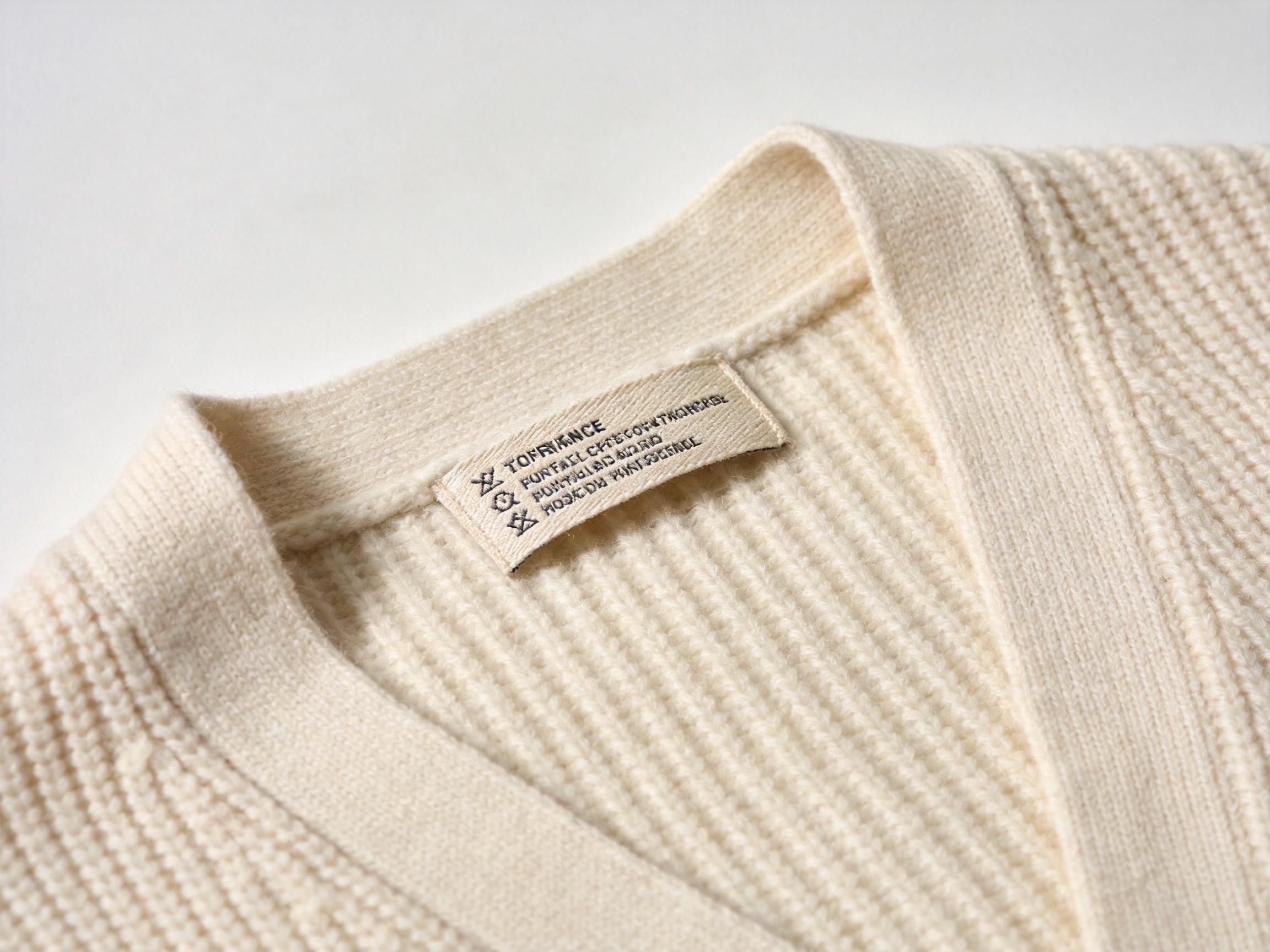
Every knitted garment that crosses a border needs a care label. It sounds simple — until you realize that the EU, US, Canada, Japan, China, and Australia each have different labeling regulations, and getting it wrong can mean customs detention, mandatory relabeling, fines, or even product recalls.
For B2B buyers sourcing knitted pullovers and cardigans from China, care labeling is where product quality meets legal compliance. A well-made sweater with the wrong label is a liability. A perfectly labeled sweater with incorrect instructions is a return waiting to happen.
This guide covers everything a wholesale buyer needs to know: the ISO 3758 symbol system, FTC requirements for the US market, EU textile labeling regulations, market-specific rules, and practical tips for working with Chinese knitwear factories on compliant labeling.
1. Why Care Labeling Matters More Than You Think
Most buyers focus on fiber content, country of origin, and pricing. Care labels get treated as an afterthought. That's a mistake — here's why:
- Legal requirement: Virtually every major market mandates permanent care labeling on textile garments. No label = no legal sale.
- Customs enforcement: US CBP and EU market surveillance authorities actively check textile labels. Missing or incorrect labels trigger detention.
- Liability protection: If a consumer ruins a garment because the care instructions were wrong or missing, the brand — not the factory — bears the liability.
- Retail compliance: Major retailers (Nordstrom, Zalando, ASOS, Marks & Spencer) have their own labeling specs that go beyond legal minimums.
- Consumer trust: A well-printed, accurate care label signals professionalism. A sloppy label signals corner-cutting.
2. The ISO 3758 Symbol System: Your Universal Language
ISO 3758:2023 (revised) is the international standard for care labeling symbols. It defines five categories of symbols, each with specific variants:
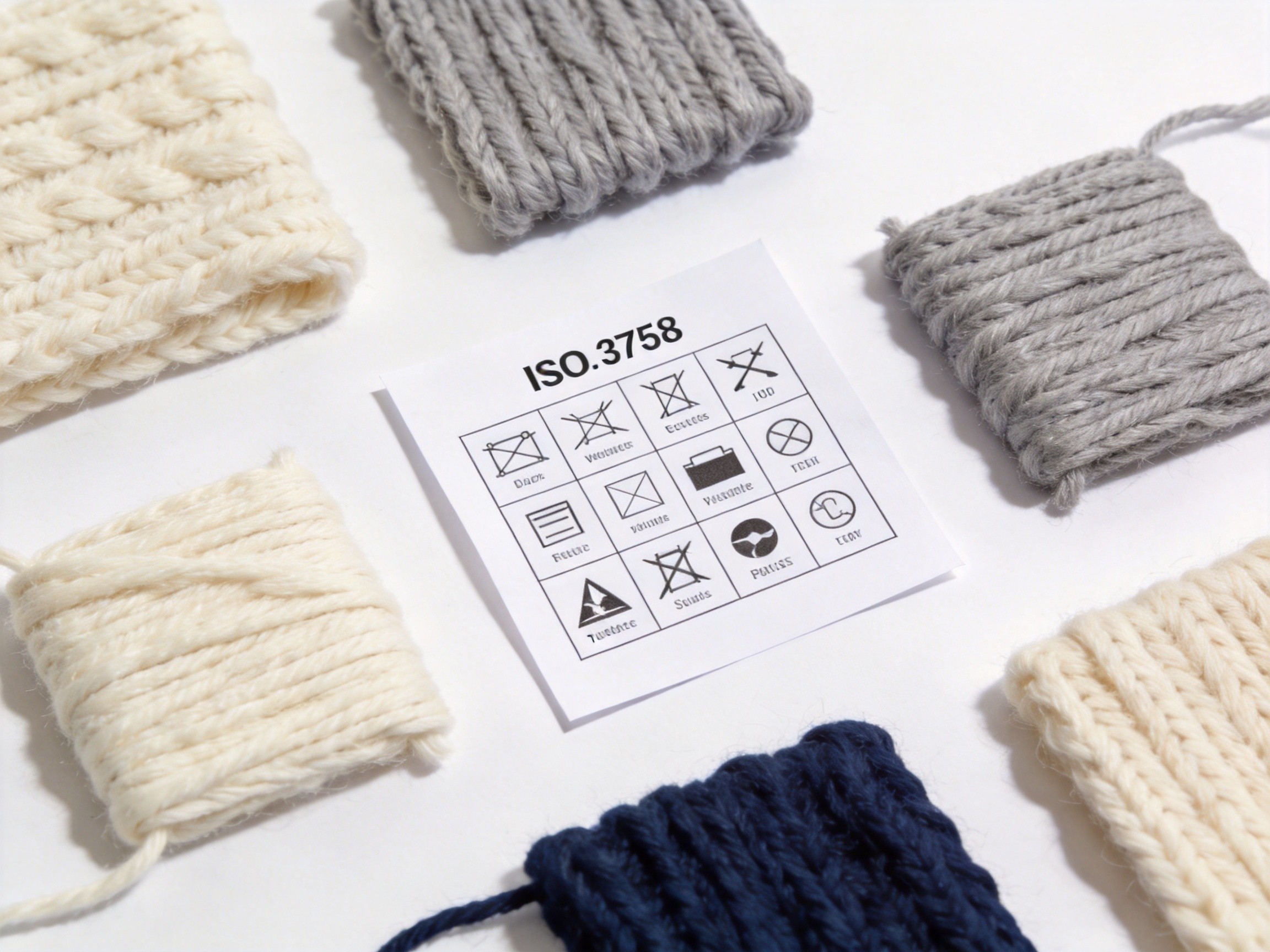
ISO 3758 care symbols — the universal language of garment care. From left: washing, bleaching, drying, ironing, professional textile care.
2.1 Washing (Washtub Symbol)
| Symbol | Meaning | Common Use in Knitwear |
|---|---|---|
| Washtub with number (e.g., 30) | Machine wash, max temperature shown | Acrylic, cotton, machine-washable wool |
| Washtub + 1 bar underneath | Gentle cycle (reduced agitation) | Wool blends, merino, cashmere blends |
| Washtub + 2 bars underneath | Very gentle cycle (delicate) | Pure cashmere, mohair, silk-wool |
| Hand in washtub | Hand wash only (max 40°C, do not rub) | Fine gauge merino, delicate structures |
| Crossed-out washtub | Do not wash (implies dry clean) | Structured garments, lined cardigans |
2.2 Bleaching (Triangle Symbol)
| Symbol | Meaning |
|---|---|
| Empty triangle | Any bleach permitted |
| Triangle with diagonal lines | Only oxygen/non-chlorine bleach |
| Crossed-out triangle | Do not bleach |
For most knitted garments in dark or bright colors, the correct symbol is crossed-out triangle (do not bleach). This is especially important for acrylic and wool blends, where chlorine bleach causes yellowing and fiber damage.
2.3 Drying (Square Symbol)
| Symbol | Meaning | Knitwear Relevance |
|---|---|---|
| Circle inside square | Tumble dry permitted | Acrylic, cotton knits |
| Circle inside square + 1 dot | Tumble dry, low heat | Wool blends (risky) |
| Horizontal line inside square | Flat dry | Most wool, cashmere, alpaca |
| Curved line inside square | Line dry | Cotton, lightweight knits |
| Three vertical lines inside square | Drip dry in shade | Delicate fibers |
2.4 Ironing (Iron Symbol)
| Symbol | Meaning | Knitwear Relevance |
|---|---|---|
| Iron + 1 dot | Max 110°C, low heat | Acrylic, nylon, most synthetics |
| Iron + 2 dots | Max 150°C, medium heat | Wool blends |
| Iron + 3 dots | Max 200°C, high heat | Cotton (rarely used for knitwear) |
| Crossed-out iron | Do not iron | Chunky knits, textured stitch patterns |
2.5 Professional Textile Care (Circle Symbol)
| Symbol | Meaning |
|---|---|
| Circle with P | Dry clean with perchloroethylene |
| Circle with F | Dry clean with hydrocarbon solvents only |
| Circle with W | Professional wet cleaning |
| Crossed-out circle | Do not dry clean |
For knitted garments, the most common professional care instruction is Circle with P (standard dry cleaning) for structured cardigans and blazer-weight knits, or crossed-out circle for machine-washable items where dry cleaning is unnecessary.
3. Market-by-Market Compliance Requirements
Care label compliance is non-negotiable for international knitwear trade. Each target market has specific labeling requirements.
3.1 European Union
- Regulation: EU No 1007/2011 on textile labelling
- Care symbols: ISO 3758 (mandatory in most member states)
- Fiber content: Must be in the official language(s) of the member state where the product is sold
- Size labeling: European size designations (EN 13402) recommended but not mandatory
- Country of origin: Not legally required for intra-EU trade, but required if importing from outside EU
- EN 71-3 compliance: Required if the garment is marketed for children under 14
3.2 United States
- Regulation: FTC Care Labeling Rule (16 CFR Part 423)
- Care symbols: ASTM D5489 standard symbols (compatible with ISO 3758) accepted since 2000
- Fiber content: English language required (Textile Fiber Products Identification Act)
- Country of origin: Required by US Customs (19 USC 1304)
- RN/WPL number: Optional if company name is on the label
- Flammability: General Fabric Flammability Act (16 CFR 1602) applies — especially for raised-fiber knitwear (fleece, brushed fabrics)
3.3 Canada
- Bilingual: English AND French required (Consumer Packaging and Labelling Act)
- Care symbols: CAN/CGSB-86.1 (compatible with ISO 3758 with minor Canadian additions)
- Fiber content: Generic fiber names must match Canadian prescribed list
- Dealer identity: Name and postal address of Canadian dealer required
3.4 Australia & New Zealand
- Standard: AS/NZS 1957:1998 — Textile care labelling
- Care symbols: Based on ISO 3758 with Australian additions
- Key difference: Requires specific warning statements in English (e.g., "Do not tumble dry" rather than just the crossed-out tumble dry symbol)
- ACCC enforcement: Active — mandatory recall power for non-compliant products
3.5 Japan
- Standard: JIS L 0001 (based on ISO 3758)
- Language: Japanese required for all text on labels
- Fiber content: Must use Japanese generic fiber names (specified by JIS)
- Unique requirement: Importer name and address in Japanese must appear on the label or hangtag
3.6 China (Domestic Market)
- Standard: GB 5296.4-2010 — Labels for textile products
- Language: Simplified Chinese mandatory
- Care symbols: GB/T 8685 (equivalent to ISO 3758)
- Additional: Must include product type, size, quality grade, and manufacturer info in Chinese
4. The Complete Label Checklist for B2B Buyers
When you place a knitwear order, here's exactly what your label needs to include — organized by what's legally required vs. commercially recommended:
4.1 Legal Requirements (Non-Negotiable)
- Care instructions — ISO 3758 symbols (wash, bleach, dry, iron, professional care)
- Fiber composition — In the destination market's required language
- Size designation — Following the target market's standard
- Country of origin — "Made in China" or equivalent
- Manufacturer/importer identity — Name and address (varies by market)
4.2 Commercial Recommendations (Strongly Advised)
- Brand name/logo — Woven or printed
- SKU/Style number — For inventory management
- Barcode (EAN/UPC) — Required by most retailers
- Hangtag — With marketing copy, price point positioning, QR code to lookbook
- Anti-counterfeit measures — Holographic labels, DNA tracing tags (e.g., DNA Trace for cashmere)
4.3 Label Placement for Knitwear
| Label Type | Placement | Common Method |
|---|---|---|
| Main care/content label | Left side seam, 10-15 cm above hem | Sewn-in satin or taffeta label |
| Size label | Center back neck | Sewn-in or printed |
| Brand label | Center back neck or left side seam | Woven label, heat transfer, or leather patch |
| Hangtag | Attached to care label or hang loop | String or plastic fastener |
5. Working with Chinese Knitwear Factories on Label Compliance
Most Chinese knitwear factories are familiar with basic labeling requirements, but compliance depth varies widely. Here's how to ensure your labels are correct:
5.1 Provide a Complete Label Spec Sheet
Don't rely on the factory to guess. Provide a detailed label specification including:
- Exact care symbol sequence (wash → bleach → dry → iron → professional)
- Fiber content breakdown (e.g., "60% Merino Wool / 40% Acrylic")
- Size designations for each market
- Label dimensions, material, and color
- Font requirements and language specifications
- Placement diagram with measurements
5.2 Order Pre-Production Label Samples
Before bulk production, request physical label samples. Check:
- Symbol accuracy — does the washtub show the correct temperature?
- Print quality — are symbols crisp and readable?
- Material — is the label soft enough for knitwear? (Stiff labels on soft knits = customer complaints)
- Durability — will the label survive the stated care method without fading or disintegrating?
- Language — is the spelling correct? (Common errors: "polyester" misspelled, wrong fiber names)
5.3 Third-Party Label Inspection
For orders above $10,000, include a labeling compliance check in your third-party inspection scope. The inspector should verify:
- 100% of random samples have correct care labels
- Fiber content matches test report results
- Country of origin is present and correct
- Label placement matches the spec sheet
- No loose threads, misalignment, or printing defects
6. Common Care Label Mistakes in Knitwear Exports
After reviewing hundreds of knitwear shipments, here are the most frequent labeling errors we see from Chinese factories:
- Wrong wash temperature: Labeling a wool blend as "40°C machine wash" when it actually requires 30°C gentle. Always test wash 3 sample garments before confirming the label instruction.
- Missing tumble dry warning: Many factories default to "tumble dry low" for acrylic knits. For wool-containing blends, this is wrong — flat dry should be specified.
- Inconsistent fiber content: The label says "100% wool" but the test report shows 95% wool + 5% nylon (from the sewing thread). The label must reflect the actual composition including any fiber above 5%.
- Wrong symbol sequence: ISO 3758 requires symbols in a specific order: wash → bleach → dry → iron → professional care. Some factories mix up the order.
- Missing country of origin: "Made in China" is absent or written as "Product of China" (technically different in some markets).
- Label material too stiff: Using standard taffeta labels on fine-gauge cashmere — creates customer complaints about scratching.
7. Smart Labeling Strategies for Multi-Market Knitwear Brands
If you're selling the same knitted pullover or cardigan in multiple markets, here are proven strategies to minimize label complexity:
7.1 Universal Symbol + Local Text Approach
Use ISO 3758 symbols as the base (universal), then add market-specific text as needed. This means one garment can carry a main label with universal symbols plus small market-specific sewn patches or printed additions.
7.2 Multi-Panel Labels
For your top 3-5 markets, create a single label with all required languages printed in sequence. Example:
- Panel 1: English (US/UK/AU)
- Panel 2: French (Canada/France)
- Panel 3: German (Germany/Austria)
- Panel 4: Spanish (Spain/Mexico)
7.3 QR Code / Digital Labeling
Some brands are adopting QR codes on physical labels that link to full digital care instructions. This is allowed in some markets (not yet in the EU or US for mandatory information) but can supplement physical labels with multilingual instructions, video care guides, and sustainability information.
Need Help with Knitwear Care Label Compliance?
New Narwhal provides end-to-end knitwear sourcing with full compliance management — from fiber testing to care label approval. We handle ISO 3758, FTC, EU 1007/2011, and all major market requirements so your garments arrive ready to sell.
Get a Compliance Consultation →Final Thoughts
Care labeling isn't glamorous, but it's one of the most important compliance touchpoints in international knitwear trade. Get it right, and nobody notices. Get it wrong, and it can cost you thousands in relabeling, delays, and chargebacks.
For B2B buyers, the playbook is simple:
- Know your target market's requirements
- Provide complete label specs to your factory
- Approve pre-production label samples
- Include labeling checks in your QC inspection
- When in doubt, consult a compliance specialist before shipping
A $0.03 label can protect a $15 garment. It's the best insurance in the knitwear business.