OEKO-TEX, GOTS & GRS Explained — A B2B Buyer's Guide to Knitwear Certifications
Published: August 2026 | By New Narwhal Knitwear Insights Team
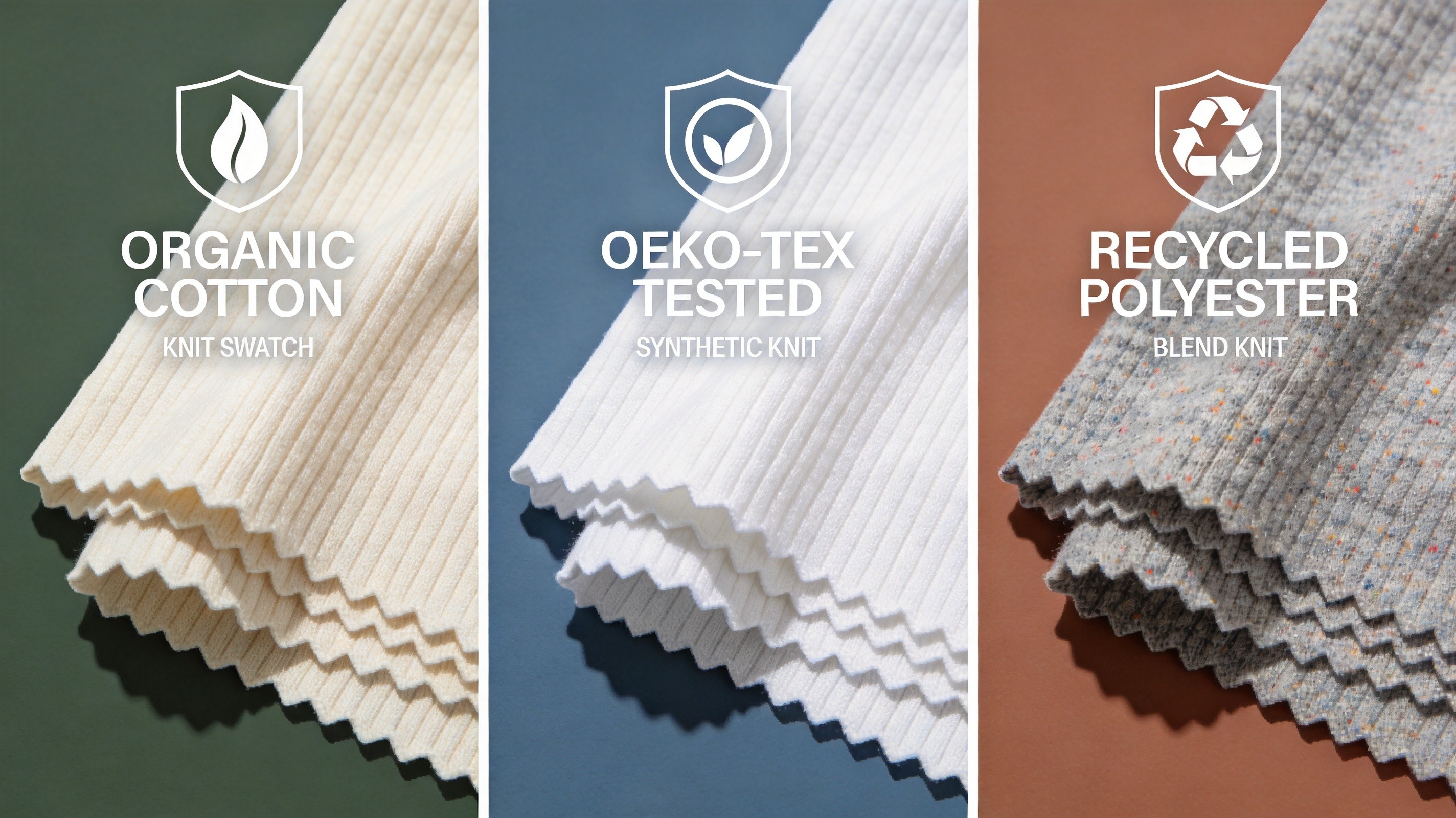
- 1. Why B2B Buyers Can No Longer Ignore Certifications
- 2. OEKO-TEX Standard 100: The Safety Baseline
- 3. GOTS: The Organic Gold Standard
- 4. GRS: The Recycled Content Credential
- 5. Side-by-Side Comparison: Which Certification When?
- 6. What Certifications Actually Cost (and Who Pays)
- 7. Building a Certification Strategy for Your Knitwear Brand
- 8. Frequently Asked Questions
If you're sourcing knitted cardigans or pullovers for the European or North American market in 2026, certifications are no longer a "nice to have." They're a commercial requirement. OEKO-TEX, GOTS, GRS — these acronyms appear in RFQs, brand compliance manuals, and retail buyer scorecards. Get them right, and you unlock premium pricing, faster order conversion, and access to the world's most valuable retail accounts.
But here's the problem: most B2B buyers don't fully understand the differences between these certifications. They ask suppliers "are you certified?" without specifying which certification — and end up with paperwork that doesn't match their market requirements.
This guide breaks down the three most important knitwear certifications in plain language. By the end, you'll know exactly which certifications to request, why they matter for your specific market, and how to evaluate supplier claims.
1. Why B2B Buyers Can No Longer Ignore Certifications
- $23.7 billion: Global sustainable fabrics market value in 2026 (Market Prospects)
- 41%: Of consumers prefer eco-friendly fabrics when purchasing knitwear
- 37%: Of new knitwear products now use recycled fibers
- 280+: New fiber blends introduced in 2023 alone, including bamboo-cotton, soy-protein, and hemp-based knits
- OEKO-TEX: Has become the "default entry threshold" for European mid-to-premium buyers
The sustainable fabrics market is projected to grow from $23.7 billion in 2026 to $62.62 billion by 2035 — a compound annual growth rate of 11.4%. This isn't a niche segment anymore. Sustainability is reshaping the entire knitwear supply chain.
For B2B buyers, the practical implications are:
- EU regulations: Minimum 15% recycled fiber content is now mandatory for certain textile categories
- Retail requirements: Major European buyers list OEKO-TEX as a default requirement in procurement
- Consumer expectations: 41% of US consumers and an even higher percentage of EU consumers prioritize eco-friendly fabrics
- Pricing power: Certified products command 20%+ price premiums over non-certified equivalents
- Order conversion: Certified suppliers respond faster to RFQs and win more contracts
As one industry analysis put it: "Certification is not one thing. A supplier can legitimately hold one and not the others, so buyers who ask only 'are you certified?' without specifying which standard often end up with a mismatch."
2. OEKO-TEX Standard 100: The Safety Baseline
🛡️ OEKO-TEX Standard 100
What it verifies: Tests finished textiles and components for 1,000+ harmful substances to ensure they are safe for human skin contact.
What it does NOT cover: Organic content, recycled content, labor practices, or environmental impact of manufacturing.
Product classes:
- Class I: Products for babies and toddlers (strictest limits)
- Class II: Products with direct skin contact (underwear, bed linen, T-shirts)
- Class III: Products without direct skin contact (jackets, coats, cardigans)
- Class IV: Furnishing materials (curtains, tablecloths)
Validity: 1 year, annual re-testing required
Cost range: Several hundred to several thousand dollars per product group
When to require OEKO-TEX:
OEKO-TEX Standard 100 is the minimum baseline for any knitwear destined for the European market. It's particularly critical for:
- Baby and children's knitwear (Class I is mandatory for most EU retailers)
- Any knitwear marketed as "safe for sensitive skin"
- Products containing synthetic dyes or chemical finishes
- Orders from European mid-to-premium buyers (who treat it as a default requirement)
For knitted cardigans specifically, most styles fall under Class III (without direct skin contact), which has the least stringent limits. However, lightweight cardigans worn over bare skin may be classified as Class II. Ask your supplier to confirm the product class matches your intended use.
3. GOTS: The Organic Gold Standard
🌱 GOTS (Global Organic Textile Standard)
What it verifies: Certified organic fibers plus environmental, social, chemical, and traceability criteria across the entire textile processing chain.
Key thresholds:
- "Organic" label: minimum 95% certified organic fibers
- "Made with organic" label: minimum 70% certified organic fibers
Supply chain requirement: Every step — from ginning to spinning to knitting to dyeing to finishing — must be independently GOTS certified. If any link in the chain lacks certification, the final product cannot be GOTS certified.
Validity: 1 year, annual on-site audits required
Cost range: Several thousand to tens of thousands of dollars annually per facility
When to require GOTS:
- Your brand positions itself as "organic" or "natural"
- You're selling to specialty organic retailers or natural lifestyle brands
- Your target consumer is willing to pay 30-50% premiums for verified organic products
- Your product uses organic cotton, organic wool, or other certified organic fibers
The supply chain challenge:
GOTS is the most demanding certification because it requires every node in the supply chain to be certified. For a GOTS-certified organic cotton cardigan, you need:
- Organic cotton farm → GOTS certified
- Gin / cotton processing → GOTS certified
- Yarn spinner → GOTS certified
- Knitting factory → GOTS certified
- Dye house → GOTS certified
- Finishing facility → GOTS certified
- Each transaction documented with GOTS Transaction Certificates (TCs)
If any link is missing, the entire chain breaks. Many buyers discover this too late — after placing orders with a knitting factory that holds GOTS certification, only to find their yarn supplier doesn't.
4. GRS: The Recycled Content Credential
♻️ GRS (Global Recycled Standard)
What it verifies: Recycled material content (minimum 20%) and chain of custody, plus additional social, environmental, and chemical management requirements.
Key thresholds:
- Minimum 20% recycled content to apply for GRS certification
- Products with 50%+ recycled content can use the GRS label on-pack
- Covers recycled polyester (rPET), recycled nylon, recycled wool, recycled cotton, and other recycled fibers
Additional requirements: Social compliance, chemical management, environmental management systems
Validity: 1 year, annual audits
Cost range: Generally lower than GOTS; several thousand dollars annually per facility
When to require GRS:
- Your brand uses recycled polyester (rPET), recycled nylon, or recycled wool
- You're responding to EU regulations requiring minimum recycled fiber content
- Your sustainability report includes recycled content targets
- Your buyers specifically request recycled content verification (increasingly common in Europe)
GRS has become especially important for knitwear because recycled polyester is the most common recycled fiber in knitted fabrics. Recycled cotton is growing rapidly (driven by the $18B+ recycled cotton market), and recycled wool is emerging in premium cardigan ranges.
5. Side-by-Side Comparison: Which Certification When?
| Dimension | OEKO-TEX Standard 100 | GOTS | GRS |
|---|---|---|---|
| Core question | Is this product safe for skin contact? | Is this product genuinely organic? | Does this product contain verified recycled content? |
| Fiber type | Any (natural, synthetic, blended) | Natural organic fibers only | Recycled fibers only (min 20%) |
| Supply chain scope | Final product testing only | Full chain — farm to finished product | Full chain — recycling to finished product |
| Labor/social criteria | No | Yes (fair labor, no child labor) | Yes (social compliance required) |
| Environmental criteria | Limited to harmful substance limits | Comprehensive (water, energy, chemicals) | Environmental management required |
| Cost | $ (lowest) | $$$ (highest) | $$ (moderate) |
| Best for knitwear | Baseline for European market; all cardigan/pullover ranges | Organic cotton or organic wool cardigan lines | Recycled polyester or recycled cotton cardigan lines |
| Market recognition | Global; EU essential | Global; EU + North America premium organic | Global; EU regulatory compliance |
6. What Certifications Actually Cost (and Who Pays)
Understanding cost allocation is critical for B2B negotiations:
OEKO-TEX Standard 100
- Testing cost: Typically borne by the supplier (factory or dye house)
- Per-product cost: Varies by product class and number of components
- Re-test frequency: Annual
- Who benefits: Both supplier (market access) and buyer (risk reduction)
GOTS
- Audit cost: Borne by each certified facility in the supply chain
- Transaction Certificate (TC): Small fee per transaction, usually borne by the seller
- Annual cost per facility: $3,000–$15,000+ depending on facility size and complexity
- Who benefits: Brand owner primarily; supplier uses it as a competitive differentiator
GRS
- Audit cost: Borne by each certified facility
- Annual cost per facility: Generally $2,000–$10,000
- Who benefits: Both supplier and buyer, especially for EU regulatory compliance
Pro tip: When requesting quotes from knitwear suppliers, always ask: "Which certifications do you currently hold, and what's the scope (product range + facility) of each certification?" Many suppliers hold certifications for specific product lines or facilities — not universally.
7. Building a Certification Strategy for Your Knitwear Brand
Not every brand needs all three certifications. Here's how to build a practical certification strategy based on your market position:
Entry-Level Strategy (Budget-Conscious)
- OEKO-TEX Standard 100 for all products — non-negotiable for European market
- Focus on Class III (outerwear) for cardigans and Class II (skin contact) for lightweight styles
- Use OEKO-TEX as a marketing point on product labels and packaging
Mid-Tier Strategy (Sustainability-Forward)
- OEKO-TEX Standard 100 for all products
- GRS certification for recycled polyester or recycled cotton product lines
- Position recycled knitwear as a distinct sub-brand or collection
- Highlight both certifications on product pages and B2B marketing materials
Premium Strategy (Full-Spectrum Compliance)
- OEKO-TEX Standard 100 for all products (safety baseline)
- GOTS for organic cotton/wool product lines
- GRS for recycled fiber product lines
- BSCI or SMETA for social compliance (often requested alongside environmental certifications)
- ISO 9001 for quality management systems
- Position as a "fully certified" supplier — commands maximum price premium
8. Frequently Asked Questions
Can a supplier hold OEKO-TEX but not GOTS?
Yes, and this is extremely common. OEKO-TEX tests the final product for harmful substances — it doesn't require supply chain certification. GOTS requires every step of the chain to be certified. A factory can easily hold OEKO-TEX without GOTS.
Does OEKO-TEX cover organic or recycled content?
No. OEKO-TEX only verifies that the finished product is free from harmful substances above safe limits. It does not verify or certify organic content (that's GOTS) or recycled content (that's GRS).
My supplier says they're "OEKO-TEX certified" — is that enough for EU buyers?
For many EU buyers, OEKO-TEX Standard 100 is the minimum requirement. However, some premium EU brands also require GOTS (for organic lines) or GRS (for recycled lines), plus social compliance audits like BSCI or SMETA. Always confirm the specific requirements of each buyer.
How long does certification take?
- OEKO-TEX: 2–4 weeks for testing and certification
- GOTS: 3–6 months (requires supply chain audit + annual surveillance)
- GRS: 2–4 months (facility audit + documentation review)
Who should pay for certification costs?
In practice, the supplier typically bears certification costs as a business investment. However, large buyers may co-fund GOTS or GRS certification for strategic suppliers. OEKO-TEX testing costs are almost always absorbed by the supplier.
Source Certified Knitwear with Confidence
New Narwhal is BSCI + ISO 9001 certified and works with OEKO-TEX-tested yarns and fabrics. We can support your GOTS and GRS requirements through our certified supply chain partners. MOQ 200 pcs. OEM/ODM/private label available.