A township smaller than 100 square kilometers — with no native wool production — manufactures roughly one in every five sweaters sold on Earth. Here's what B2B buyers need to know about the future of knitwear sourcing.
If you've ever purchased a knitted sweater, cardigan, or pullover from a global retailer, there's a statistically significant chance it came from Dalang — a single township in Dongguan, Guangdong Province, China. The numbers are staggering: 900 million knitwear pieces per year, generating over 72 billion yuan ($10.64 billion) in annual transactions, exported to more than 160 countries.
But Dalang's story in 2026 isn't about volume alone. It's about a fundamental transformation from mass production to intelligent, technology-driven manufacturing — and what that means for B2B buyers evaluating their knitwear sourcing partners.
By the Numbers: Dalang's Knitwear Empire
900 million sweaters produced annually
37,000 businesses in the knitwear cluster
150,000 computerized flat knitting machines
10,000+ high-end seamless knitting machines
~10,000 new yarn varieties developed per year
200+ yarn patents (80% specialty yarns)
160+ export countries and regions
$10.64 billion annual transaction value
These aren't projections. This is current production data from what has earned the title "World's Knitwear Capital" — a concentration of manufacturing capability that has no parallel anywhere on the planet.
The Smart Manufacturing Revolution
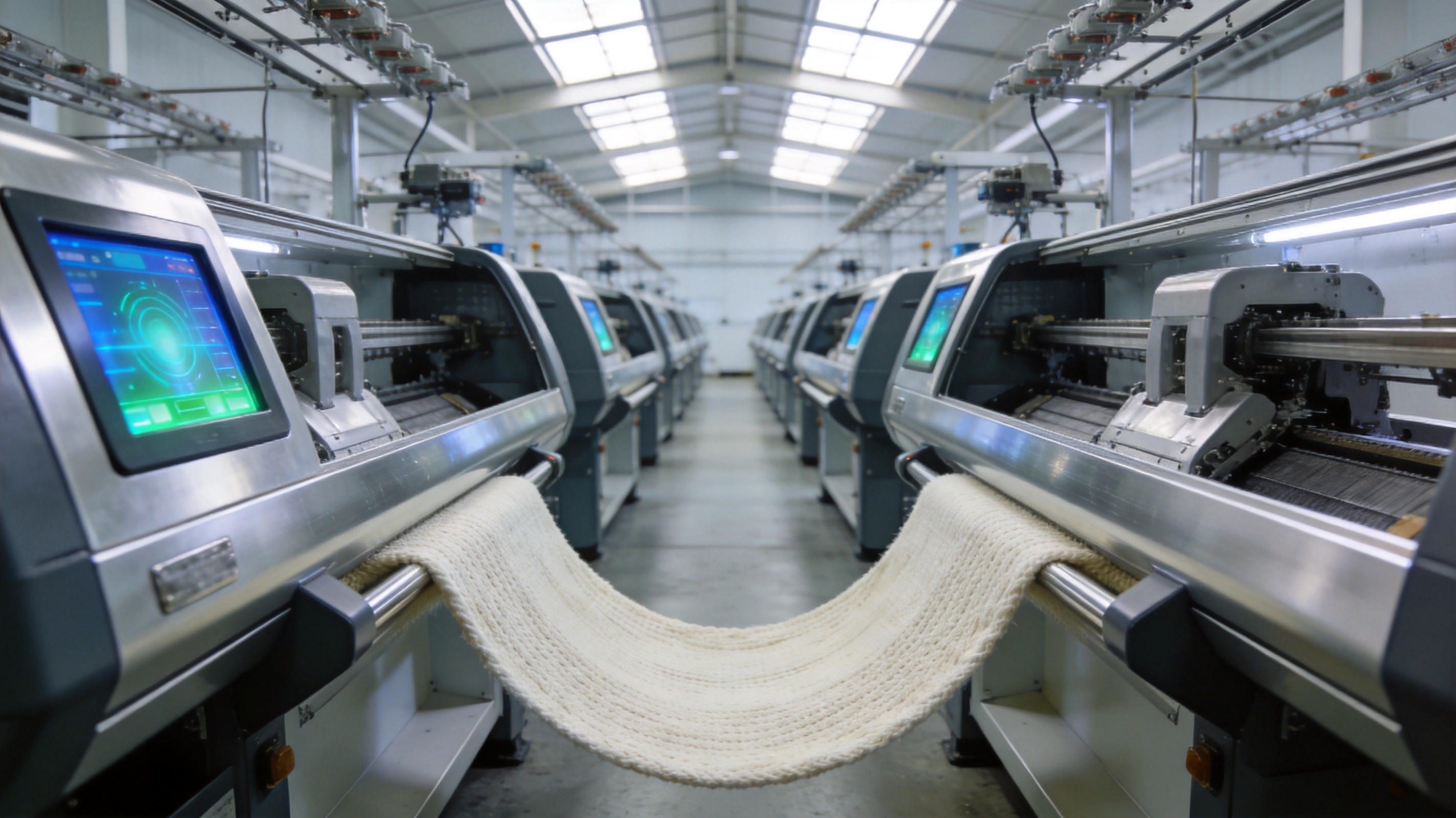
The image of knitwear manufacturing as labor-intensive craft is outdated. Visit a facility like Dongguan Xinhongfeng Garment Co., and you'll find a production floor where rows of computerized seamless knitting machines operate with minimal human intervention. The company's operations center features a video wall of 200+ HD cameras providing real-time monitoring.
Their trajectory is instructive: they introduced their first 20 computerized flat knitting machines in 2019. Today, they operate over 500 fully integrated seamless knitting machines. A conventional sweater design goes from yarn to finished garment in approximately 50 minutes.
This is the new baseline. Across Dalang, businesses collectively operate 150,000 computerized flat knitting machines — including more than 10,000 high-end seamless units capable of producing complex constructions without traditional cut-and-sew waste.
What This Means for B2B Buyers
- Faster sampling: Computerized machines can produce a sample in hours, not days. This compresses the development cycle and reduces time-to-market.
- Lower minimums become viable: Smart machines handle smaller production runs economically, enabling boutique buyers and emerging brands to access factory-direct pricing.
- Consistent quality at scale: Computerized production eliminates human variability in stitch tension, gauge, and construction — critical for repeat orders.
- Complex designs are no longer premium: Intricate jacquard, cable, and openwork patterns that once commanded high premiums can now be executed efficiently on modern equipment.
AI-Powered Design: From 3 Days to 2 Hours
Perhaps the most transformative development is Dalang's adoption of AI in the design process. At the China (Dalang) International Woolen Knitwear Fair held in June 2026, a purpose-built AI large language model for knitwear design attracted significant attention.
The system is built on a database of more than 2 million knitwear design images. When a designer enters a few keywords, it generates multiple design proposals within 1-2 minutes — complete with 360-degree visualization and simulated on-body renderings.
Design cost reduction: 60%+
Sample production time: From 3 days → 2 hours
Database: 2,000,000+ knitwear design images
For B2B buyers, this has a direct commercial impact. When you send a reference image or describe a concept, your supplier can now generate visual options and physical samples in a fraction of the traditional timeline. This means:
- Faster response to emerging trends
- More iterations before committing to bulk production
- Reduced development costs per style
- Better alignment between design intent and production reality
The High-End Shift: From Volume to Value
Dalang's evolution isn't just technological — it's strategic. The township is actively moving up the value chain.
Consider Tongfa Knitwears, a representative high-end manufacturer in the cluster. Their chairman, Liu Dianyu, puts it directly: "Dalang's knitwear industry has moved well beyond the traditional model of mass production and competing on volume."
Their numbers tell the story:
- Annual sales growth: 20-30%
- Export focus: 70% to Europe and the United States
- Factory price range: $25-$30 per garment
- R&D investment: 1/3 of workforce in design and product development; ~50% of operating costs dedicated to product development
- Next step: Opening a European design studio for co-branded collections
This isn't a low-cost commodity play. This is design-led, quality-focused manufacturing targeting premium Western markets.
Yarn Innovation: Beyond Traditional Wool
Dalang's innovation extends beyond the knitting machines to the raw materials themselves. Local companies develop nearly 10,000 new yarn varieties each year — including functional fibers, environmentally friendly materials, and specialty blends that have expanded well beyond the traditional definition of wool knitting.
The township's yarn producers hold more than 200 patents, with over 80% relating to specialty yarns. These account for approximately two-thirds of all specialty yarn patents in China.
For B2B buyers, this means access to:
- Recycled fiber blends (supporting GRS certification programs)
- Functional performance yarns (moisture-wicking, temperature-regulating)
- Premium natural fiber blends (alpaca, mohair, cashmere mixes)
- Proprietary textures and hand-feels unavailable from generic suppliers
What This Means for Your Sourcing Strategy
Key Takeaways for B2B Buyers
- The cluster advantage is real. 37,000 businesses in one location means competitive pricing, diverse capabilities, and rapid supplier switching if needed.
- Technology = lower risk. Computerized production means consistent quality, faster sampling, and the ability to re-order exact specifications months later.
- AI design access = speed. Partners with AI design integration can respond to your concept in hours, not weeks — critical for trend-responsive buying.
- Premium capability exists at scale. This isn't just a cheap-mass-production hub. The high-end segment ($25-$30 factory price for Europe/US markets) is well-established and growing.
- Yarn innovation opens differentiation. Access to 10,000 new yarn varieties per year means you can develop exclusive fabrications that competitors can't easily replicate.
How to Evaluate Dalang-Based Suppliers
Not all 37,000 businesses are equal. When sourcing from this cluster, evaluate:
- Machine count and type: Do they operate computerized flat knitting or seamless machines? How many?
- Design capability: In-house design team? AI tool adoption? Ability to work from reference images?
- Export experience: Track record to your target market? Understanding of compliance requirements (OEKO-TEX, GRS, etc.)?
- Yarn sourcing relationships: Access to specialty yarns? Ability to develop custom blends?
- MOQ flexibility: Can they handle your order size efficiently? Smart machines enable smaller runs.
- Communication infrastructure: English-speaking sales teams? Digital collaboration tools?
The Broader Context: China's Knitwear Export Evolution
Dalang's transformation reflects a broader shift in China's knitwear export industry. The Foshan municipal government recently signed a deal to establish a dedicated clothing export base in Zhangcha — another major knitwear cluster — covering 5,000 square meters with full-process export services including design, sourcing, customs clearance, logistics, and overseas branding.
Meanwhile, the global traceability landscape is tightening. As of August 2026, major brands like Gap Inc. and ASOS are deploying AI-powered supply chain platforms (Inspectorio, TrusTrace) to map sourcing from finished-product factories to raw-material sources. California's textile EPR law took effect July 1, 2026, and the EU's Digital Product Passport registry became operational, establishing infrastructure for mandatory apparel compliance documentation.
For B2B buyers, the implication is clear: suppliers who can provide verified, structured documentation — bills of materials, chain-of-custody records, fiber origin data, and compliance certificates — will increasingly be the only suppliers who qualify.
The Competitive Landscape: Dalang vs. Other Sourcing Hubs
Dalang isn't the only knitwear manufacturing hub globally, but its combination of scale, technology adoption, and vertical integration is difficult to match. Here's how it compares:
- Taizhou, China: Known for mid-range knitwear with strong export capabilities. Good for volume programs but less advanced in AI design integration.
- Puyuan, China: The "Knitwear Capital of China" with a massive trade market. Strong in wool and cashmere segments but more fragmented production base.
- Bangladesh: Competitive on cost for basic knits but lagging in technology adoption and specialty fiber processing.
- Italy (Carpi/Biella): Premium quality leader but significantly higher cost structure and longer lead times. Best for ultra-luxury programs.
- Turkey: Strong in cotton knits and mid-market positioning. Good geographic proximity to EU but less scale in technical knitwear.
Dalang's advantage is the breadth of its ecosystem. You can source yarn, design, prototype, produce, and export — all within a 100-square-kilometer radius. This vertical proximity reduces logistics costs, accelerates communication, and enables rapid iteration.
Emerging Trade Dynamics to Watch
The global knitwear trade landscape is shifting in ways that directly affect sourcing decisions:
US Tariff Changes (Aug 2026): The US has added 50% tariffs on selected Canadian textiles effective August 19, 2026. While this specifically targets Canadian-origin goods, it signals continued tariff volatility that affects sourcing cost calculations across all origin countries.
India's Growing Role: At Yarn Expo Autumn 2026 (Aug 25-27, Shanghai), India's pavilion is doubling its presence with 40+ exhibitors. India is positioning as a competitor in cotton yarn and sustainable fiber solutions, though it remains less developed in finished knitwear manufacturing compared to China's clusters.
EU Compliance Requirements: The EU's Digital Product Passport (DPP) registry became operational in July 2026. While textile-specific implementation dates are still forthcoming, the infrastructure is being built. Suppliers who can provide structured, machine-readable compliance documentation will have a significant advantage when DPP requirements go live.
The Bottom Line
Dalang's 900 million sweaters per year represent a manufacturing concentration that will not be replicated elsewhere. But the more important story for B2B buyers is what's changing beneath that volume: AI-driven design, seamless knitting technology, premium yarn innovation, and a strategic pivot from commodity production to design-led, quality-focused manufacturing.
If your knitwear sourcing strategy hasn't incorporated these capabilities, you're competing with one hand behind your back.
Source Knitwear from China's Premier Manufacturing Clusters
At New Narwhal, we match B2B buyers with verified factories across Dalang, Taizhou, and beyond — with full capability assessment, compliance verification, and production oversight.
Get a Quote for Your Knitwear Program